Jerry, The Student (Undergrad Years)

In this installment of Jerry’s Story, we’ll cover his experience as an undergraduate student. Refer to the home page for Jerry’s Story to navigate to other installments.

Earlier, we learned how Jerry ended up starting college at the University of Nebraska (in “An aspiring auto mechanic changes course“). This was in the Fall of 1950. Because he had skipped two grades in elementary school, Jerry was only 16 years old; it was still a few months before his 17th birthday. Despite the age difference with the vast majority of his peers, he seemed to fit in better in college than he had in high school. He no longer felt the need to hide his intelligence to avoid bullying, and he made friends with other smart people. He didn’t have any financial help from his parents, so he didn’t consider any other schools that were more expensive.
2278976753_562f2fb122_o

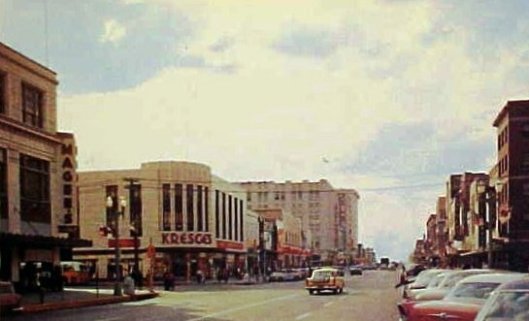
Lincoln, Nebraska in 1955. The University of Nebraska is a few blocks to the right. Photo credit: army_arch

Jerry told his counselors that he wanted to work with computers. There were no classes in computing and there were no computers on the campus at all. The only thing the counselors knew about computers was that they had something to do with electrical engineering and physics. Because he was good in mathematics, they recommended that he major in physics, thinking that his math talents wouldn’t be put to good use as an electrical engineer.

He took an exam that allowed him to skip the freshman English composition class and go straight to advanced English composition. He found out that the advanced class covered everything from the regular English composition class in just six weeks and then continued on to more advanced topics for the rest of the semester. He wasn’t excited enough about studying English to be interested in an intense class like that, so he signed up for the basic English composition class. At the beginning of his book Weinberg on Writing, Jerry told the story of how he met the professor, Wilbur G. Gaffney–generally known to his students as Bill–

On the first day, we assembled on the second floor of Andrews Hall, only to discover that our section was actually two sections, with two different instructors. We stood in the hall while the instructors counted us off, one-two, one-two, to divide the class. I was a one.

The instructors were both men, but there the resemblance ended. One was skinny, immaculate, clean-shaven with hard eyes and bony cheeks. And no smile. The other was rotund, clothed in wrinkles, with a white walrus mustache covering plump, rosy cheeks. He smiled as if he’d just taken a nip before class. I had no doubt as to which one was for me, but unfortunately, Bill Gaffney, the Walrus, was taking the twos. So, of course, I had to cheat.

I just moved with the twos. It was one of that handful of truly life-changing moments.

Jerry dutifully completed his first writing assignment for the class, which earned a C-plus and a lot of red marks on his paper. For his second assignment, he couldn’t stand writing about a topic he wasn’t interested in. So instead, he wrote a paper explaining why he wasn’t going to do the assignment or any other assignment like it. He wasn’t surprised at the professor’s response, at least at first–

On Wednesday, the graded papers were handed back, but I didn’t get one. Instead, Gaffney handed me a note in red ink saying to come to his office after class. I was right. My brief college career was over.

His corner office was a mess, more rumpled than his tweed jacket, more tangled than his walrus mustache. Books piled everywhere. Reprints on every horizontal surface except the ceiling. Pipe smoke odor permeating everything. He motioned me to clear a space on one of the two wooden chairs, then shut the door on the passing student throng. He returned to his desk and picked up what I recognized as my message. It had red marks all over.

I took a deep breath, probably my last as a matriculated student. Before handing me the paper, Bill Gaffney packed his pipe, lit it with a Zippo, and blew out a huge cloud of pungent smoke. I didn’t want to say this in front of the class … He puffed out another Vesuvian billow. … but in all the years I’ve been teaching freshman English composition … Another gargantuan puff. … this is the best paper I’ve ever received.

He handed me the paper. I forgot to close my hand, and the pages fluttered to the floor. He continued speaking to my bent back. Your argument has totally convinced me, so from now on, you’ll just ignore the assignments I give to the rest of the class. You’ll still have to turn in a paper every week, but you’ll choose whatever topic, whatever style, and whatever length you wish.

Bill Gaffney had years of experience as a professional editor in New York, which made him a more effective writing teacher. Jerry took several classes from Gaffney, learning a lot about the mechanics of English and how to revise his writing so it “sang on the page.” Jerry even worked for Gaffney, helping to grade essays. Jerry read hundreds of essays from freshman composition classes, never receiving any coaching from the professor on how to grade them. Jerry actually had worked for a different professor before then, but he quit when he saw that professor adjusting grades upward for his favorite students and downward for the rest.

When reading all those essays, Jerry observed rudimentary spelling and grammar mistakes, and also mistakes of thinking and reasoning. This went a long way toward shaping his writing skills, and he was happy to get paid to do it. Gaffney became of one of Jerry’s lifelong friends.

When he started at the university, Jerry joined a social fraternity and moved into the fraternity house. He thought that’s what everyone did. The fraternity had a contest where the members bet on what the freshmen’s grade point average would be at the end of the first semester. Jerry was still good at concealing his intelligence, so much so that he was given the longest odds of having the best grades. One fraternity brother bet on Jerry and later won a lot of money when Jerry came out on top of the grades list. The two became friends and bridge partners.

Jerry and his partner won the school’s bridge tournament two years in a row, and also went on to be NCAA regional champions one year. Jerry got a productive friendship from his experience at the fraternity, but once he learned more about how the fraternity conducted itself, he realized that it wasn’t a fit for him, so he left the fraternity.

The University of Nebraska was a land-grant college, which at the time, meant that students were required to join the Reserve Officers’ Training Corps (ROTC). Jerry joined the Army ROTC program. His habit of skipping class and not bothering to wear the required uniform earned him demerits at a rapid rate. When he reached 300 demerits, he was required to report to the commander, a Colonel, which could have resulted in him failing the program. Jerry described what happened:

When I went in to his office, he was playing bridge with three of his underlings. I watched until the commander’s partner, a captain, played a hand but did not make the contract. Captain said Colonel had overbid. I said, no, the contract should have been made if played properly. After a few more hands, Captain had to leave and Colonel invited me to be his partner. We beat the pants off the two majors, and it turned out they were playing for money. Colonel asked why I had come to see him. I told him about the demerits and he waved them away, on condition that I come twice a week to be his bridge partner.

Jerry didn’t just get his demerits erased. He no longer had to march in parades; he checked out the rifles for the parades instead. The commander even bought him socks to match his uniform.

Jerry quickly became a good marksman. He could take the rifles apart and reassemble them blindfolded. He became a rifle instructor while he was still a freshman. Years later, his shooting skills helped out when we was living in Switzerland. He visited a few local fairs and showed his skills at target shooting. He thinks the locals really valued marksmanship, and this helped his family fit in to their new community.

The only thing Jerry ever killed with a gun was a rabbit he once spotted in his garden. It’s wasn’t a pleasant memory–

I saw it die, and I felt terrible. I did give the corpse to a friend who made a rabbit stew, which made me feel temporarily better about the shooting, but it was really unnecessary. I guess I thought I could make a near miss and scare the poor thing away, but I was too good a shot.

Early in his second year at the University of Nebraska, Jerry started having health problems that were so severe that he moved back home to Omaha. After three major surgeries, he was finally diagnosed with Crohn’s disease. His weight had dropped to 110 pounds. He become addicted to morphine during this ordeal, but was forced to quit during one of his hospital stays.

He must have had some good days while back in Omaha. There was an event Jerry wanted to attend, perhaps a dance at the University of Omaha. For his date, he had his eye on a girl named Joan. But Joan was hard to reach on the phone. Unable to talk to Joan, he thought of her close friend Pattie. He knew Pattie because she sometimes helped at her father’s paint store. When Jerry had helped at his father’s auto body shop back in high school, he would occasionally see Pattie when he picked up paint supplies. She was a high school senior at this point and still living in Omaha. She accepted the invitation, and they had their first date.

After spending almost a year in Omaha, Jerry had recovered from the worst of his symptoms, though he would suffer from the effects of Crohn’s disease for the rest of his life. He returned to Lincoln to continue his studies at the University of Nebraska. Pattie also enrolled there, where she moved in to a sorority house. As a result of his ongoing health problems, Jerry was given a 4F classification by the Army, which meant he was released from his obligation to participate in ROTC.

What started as a date of convenience in Omaha turned into something more over the next year. By the time Jerry went to work a summer job at 3M in Saint Paul, Minnesota, he couldn’t stand to be away from Pattie. He said, “I don’t recall that there was a proposal. We both knew we were going to marry. It certainly was planned, with all the ridiculous fuss that implies.” In August 1953, when Jerry was 19 years old and she was 18, Jerry married Patricia Anne Korney in Omaha.

Jerry felt strongly that the doctors in Omaha had saved his life. He wanted to be a “heroic doctor” to give back to society, so he decided to become a pre-med student. He was already planning to take all of the science courses required by the pre-med program, so it didn’t actually require any change of coursework. But he was willing to give up on a chance to work with computers to take this path.

Then, on a lovely Spring day, another student stopped me outside between classes and asked if I was going to the initiation ‘tonight.’

‘What initiation?’ I asked.

‘The pre-med honorary society.’

‘Why would I go there?’

‘Your name was on the list.’

‘I didn’t see any list.’ It had been posted, but I hadn’t seen it or thought it had anything to do with me.

He explained how being in this society (I forget the name) increased your chances of being admitted to a good medical school, so I asked for details. He gave me time and place, then said all it cost was a 50 cent initiation fee.

‘Oh,’ I said, my mind clearing. Suddenly I knew that my desire to become a doctor wasn’t worth fifty cents. That was the end of my medical career.

Thinking that he couldn’t get into medical school without joining this society, and thinking that he’d rather being able to afford an order of French fries than pay to go to the meeting, Jerry abruptly dropped his plans to go to medical school. Later, after several more experiences with doctors and also comparing notes with others, he concluded that in fact the doctors had almost killed him with their treatment.

One of the many subjects Jerry explored at the University of Nebraska was psychology. But he dropped his psychology class after only going to a few lectures. Why? “A really stupid lecture in a huge classroom. The lecture seemed full of obvious or ridiculous stuff. I think I’d hoped it would teach something about intelligence, but clearly that wasn’t going to happen.” He would come back to psychology many times later in his life, however, referencing it in his writing and even learning how to be a therapist.

He appreciated being introduced to anthropology and was disappointed that the university didn’t offer an undergraduate major in the subject. This is another subject he would stay close to throughout his life.

Jerry enjoyed his physics classes, especially when he got to work in a lab. He worked as a teaching assistant for a freshman physics lab at age 17, and was told he was the first undergraduate ever to get a TA job in that department. He remembered a physics project that involved building a crude copy machine. It consisted of an inflated plastic hood and a camera, and you’d develop and print the picture to get the copy.

For many of his classes, if there was a textbook, he would read it in a day or two, and then he had learned all he would learn from that class. This didn’t always lead to good grades, though. In his differential equations class, the students would learn a progressively more sophisticated method of solving the equations each week. Jerry read ahead and learned better ways to solve the problems the class was currently working on. But his work was counted wrong if he didn’t use the technique he was supposed to be using that week. He didn’t understand the need to use inferior techniques if he could skip ahead and use better methods.

A letter to the editor of the university’s student newspaper at tells us how Pattie and Jerry felt about the quality of the journalism the newspaper was producing. This is possibly the first example of Jerry’s writing that was ever published:

Letterip column

The Daily Nebraskan, March 2, 1954, page 2

Dear Editor:

We are of the rapidly growing group of students who believe that the function of The Nebraskan is to protect the hair of coeds on rainy days. Since most coeds own scarves which do almost as good a job, we question the advisability of continuing to dissapate (sic) University funds on paper hats.

If, however, the function of the paper is to busy the idle hands of journalism students, those students alone should pay the expense or see that the paper pays for itself. As for the argument that The Nebraskan serves as a carrier of the torch of truth to the student body, we question whether a candle wouldn’t shed more light with less smoke. Furthermore, we question whether the students are really in the dark; whether they really want the Rag at all.

We challenge the editors of this paper to publish this letter (without editing); and with it, a request for letters of confidence from members of the student body (other than staff members and workers) which would have to be signed and delivered in person to the Rag office. In this way, we would test how many students really want The Nebraskan badly enough to make this slight effort to back up the staff and its policies. No petitions, please; and no surveys—just personal letters delivered in person.

Even twisted journalism can be interesting and well written; but how about you? Or is bad journalism better than no journalism?

Pat and Jerry Weinberg

The editors probably delighted in meeting the challenge of not editing the letter except for adding “(sic)” after the misspelling. In fact the letter did motivate another reader to send a vote of confidence that was published three days later. And a month later, another reader wrote in expressing confusion over the meaning of the “(sic)” annotation, and adding a nonsensical request that seemed to parrot Pattie and Jerry’s letter: “Do not edit this letter. If you can’t print all of it, don’t print any of it, or you’ll ruin the whole train of thought and the reasoning behind it.”

I asked Jerry about his letter 64 years after it was published, and he couldn’t recall what journalistic offense had prompted it or whether it was he or Pattie who wrote it. There is another letter that Jerry alone wrote that was published about a year later. In this one, he expressed his disappointment at a few misrepresentations of Alice in Wonderland he had noticed in an editorial.

Jerry was a long-time fan of Alice. Using his IBM Selectric typewriter, he corresponded several times with Martin Gardner regarding Gardner’s book The Annotated Alice some time after it was published in 1960. In The Annotated Alice: The Definitive Edition, Gardner mentioned him in two places and included some of Jerry’s insights about the text. The book also cites an article written by Bill Gaffney.

In 1955, Jerry graduated magna cum laude from the University of Nebraska with a Bachelor of Science degree. He was nominated for the Phi Beta Kappa (humanities) and Pi Mu Epsilon (mathematics) honor societies. His curriculum vitae also lists the Sigma Xi science honor society, though it doesn’t say when that happened. He was ranked third in a class of about 5000, but he remembers marching in to the graduation ceremony at the front of the line, next to the man who was first. Second place was a woman, and she was required to march behind them. It’s not clear why the school did this to her. Jerry felt bad because she was treated unfairly.

The record isn’t quite clear on what subjects he majored in. Jerry consistently claimed to have majored in both physics and mathematics. But he told me and others that he also majored in English and philosophy, for a total of four majors. He has also said that the university only allowed two majors, so it seems plausible that he may have met the requirements for all four, but was only officially recognized for two of them.

In addition, Jerry earned honors in all four subjects by completing these special projects:

  • Physics–reproduced the Michelson-Morley experiment (in 1887, it helped to disprove aether theory and eventually led to special relativity).
  • Math–competed in an annual math competition and took second place (the son of the head of the math department took first place).
  • English–wrote an essay, the subject of which is long forgotten.
  • Philosophy–studied and wrote about some of Isaac Newton’s philosophical work.

Much later, in 2008, Jerry was among the first people inducted into the Nebraska Hall of Computing that’s sponsored by the University of Nebraska. He thought this was funny, given that he had asked to study computers when he was a student there, but there was none to be found anywhere on the campus. The other five honorees for that year are pictured wearing suits in formal portraits. Jerry’s picture shows him in an action shot wearing casual clothes and a lanyard. Formalities never seemed necessary to him.

The next installment is: Jerry at Berkeley.

Jerry’s Story: Competitive Eating–Permission to Make a Mess

In this installment of Jerry’s Story, I’m not going to risk turning a lively discussion into a pile of sterile facts. I’ll present the email discussion we had with little editing.

We were talking about whether having unlimited access to ice cream might lead to weight gain, and how he gained so much weight he was offered a football scholarship. But it wasn’t just the ice cream.


(Jerry Weinberg) I was a champion eat-contest participant. My specialties were watermelon, pie, and hot dogs.

(Danny Faught) You’re still full of surprises! What age did that start, and what got you started?

I must have been 15. In Omaha. The first one I recall was at a birthday party. I ate 36 hot dogs.

Then, at the University of Nebraska, they held these contests fairly regularly.

I imagine that this was a cultural trend at the time. Seems that would make it expensive to throw a birthday party, though, supplying all that food. 

What kind of prizes did you win from competitive eating?

I don’t recall. They must have been insignificant. Besides, it was the glory that I was after.

How long did you continue to compete before you lost interest?

I never lost interest, but once I had Crohn’s Disease, my eating habits had to change drastically.

How did you feel about winning? (Or in other cases, not winning?)

Mostly I won. I was very good, and knew the secrets. Like not worrying about seeds in the watermelon, and managing to spill most of the melon on the floor as I swung my mouth back and forth.

This would be a very different kind of watermelon time. 🙂

Indeed.

Sandia.jpg

The Sandia Mountains as viewed from Jerry’s back yard. Jerry said, “It’s like a big watermelon and it turns red when the sun is going down. They call it ‘watermelon time’ here. It’s very special.” “Sandía” means “watermelon” in Spanish.

How did I feel? I expected to win, so it was no big deal. I suppose I would have felt bad if I had lost, but if I lost, I must have felt so bad that I erased all memory of it.

How did you learn the secrets that helped you win?

Through experience, I guess.

So nobody cared that so much of the watermelon was on the floor rather than in your stomach?

Not at all. Watermelon spectators expect a certain amount of slop on the floor. In fact, that’s one of the attractions, different from polite everyday life.

Was this an attraction to you, to have permission to make a mess?

I don’t think I ever needed permission for that.

Awesome. Tell me more about messes you made.

While eating?

Whatever you were thinking about when you said you never needed permission to make a mess.

In general, I’ve lived by the credo that it’s better to ask forgiveness after than permission before. I was always doing new things that people didn’t understand until after they’d seen the results.

Who else do you know who follows this credo? Any examples of them having similar successes as you, or ever having big regrets about it?

I recall discussing this with Ken Iverson, creator of APL (and a good friend). He was certainly successful.

I think I may have learned it from Jim Turnock, my boss for a while at IBM, who headed the Mercury (IBM) projects.

Have you counseled people to stop asking for permission?

Many.

I can recall cases of you telling me *to* ask for permission, like when asking someone for a hug.

Yes, that’s definitely a case where you should honor another’s personal space.

Examples? Well, there’s all the many experiential exercises I’ve concocted. People generally didn’t understand why I didn’t just lecture, so I never asked permission, and some of those exercises definitely looked like messes.

And that’s just one example, with dozens of sub-examples.

Are these the attitudes of the people participating in the exercises?

Well, I should correct myself a bit here. I always ask permission of the participants. As you may recall, before any exercise, but with particular emphasis on new, untried ones, I always remind people of their right to refuse or to drop out. That way, I always have permission, because they have permission to take care of themselves. And, I make sure they don’t have to ask permission if they want to drop out. Nor do they have to explain why they want to.

How does it go from looking like a mess to being a great success? (Depends on who thinks it’s a mess, I think.)

You’re right. But, for example, in some exercises we make a great physical mess (as in House of Cards, which winds up with cards all over the walls, floor, and even ceiling). Even then, make the mess part of the exercise, and try to make it reversible (no permanent damage to the premises).

Sometimes, though, an exercise makes a “mess” of a participant’s model of the world. That’s really the point of the exercise, but I always try to work with that participant to make a new model to replace the mess.

What’s another example of not asking permission?

One great example was in the Mercury Project. To do a real-time system on the IBM 709, we needed an interrupt clock, and there wasn’t one on IBM’s machine. We did ask for one to be built, but IBM refused. So, we just snuck into the factory and soldered in our own interupter without telling anyone.

The funny part of this story is that when a machine arrived in Bermuda, it was a different machine, so we had to put in another interrupter. And we never did find out who got the other machine, and if they even noticed the non-standard interrupter.


And that’s where we left it. Several months later, Jerry sent me a news article about the winner of the Nathan’s Famous hot dog eating contest, adding “I was never in his class.” This prompted me to try several different angles to learn more about the context of his competitive eating experiences. I got a few more facts, but nothing that really furthered the story. I searched the student newspaper for the University of Nebraska to see if he was ever mentioned as a winner, and I came up empty, but I did uncover several other interesting things about his college experience to talk about. And that’s how the stream of consciousness of our discussions went.

The next installment is Jerry, The Student (Undergrad Years).

Jerry’s Story: In Memoriam

Yesterday the news of Jerry Weinberg’s death was announced. I have lost a friend and a mentor. I am sad, but like many others, I am also feeling a great deal of gratitude for Jerry’s life. He was kind, and brilliant, and so many other things that I plan to share to the best of my ability. He lived a full life. An oversized life. This earth is better for his presence. I’m not going to try to write a summary of his accomplishments right now–that would fill a book, and that’s what’s I’m trying to do a little bit at a time.

My biography project has turned a corner. From now on, the new information I gather must come from indirect sources rather than directly from Jerry’s own vivid memories. Knowing that Jerry wouldn’t be around forever, I focused on asking him about events early in his life that would be hard to know from any other source. There are a still a few subjects that will be difficult to research, like his programming experiences before he started consulting on broader topics. I hope I can count on some of the thousands of people who were touched by Jerry to help me understand more about his story.

fieldstone

A fieldstone wall I encountered at the Quiraing landslip during a recent trip to Scotland. I couldn’t help but think of Jerry every time I saw fieldstone, so I sent him a few pictures of what I saw, including this one.

I am so happy that I started sending him my barrage of countless questions a few years ago, which he patiently answered. The biography project was somewhat of an artificial catalyst for us to start interacting more than we ever did before, but we were both pleased to have the motivation to swap stories with each other. This was how it all started:

Screen Shot 2018-08-09 at 8.40.28 AM

I asked him if he ever thought about writing about early computer history, and he replied, “I’ve thought about it, but it’s not my cup of tea. But why don’t you write it?” I found out later that when people pitch book ideas to him, he often reflects these requests back to where they came from. When it became clear that the project would work better as a biography, he was even more insistent that someone other than him should write it. No one else seemed to be doing it, so I decided to give it a try.

Since then, I have logged more than 300 pages worth of conversations with him. It will take some work to turn it into cohesive chapters, but I’m enjoying the process of organizing the extensive set of fieldstones I’ve collected while also still adding to the pile (see Jerry’s book Weinberg on Writing: The Fieldstone Method if you don’t know why I’m referring to stones). Recently, his replies had slowed their pace, until this, the last email he ever sent me–

TOO SICK TO WRITE.

SEND MUCH LATER.
JERRY

Jerry still has a lot to say to us all. He has left behind a rich legacy for us still to discover. Rest well, my friend. You have sent us much.


Next up: Competitive Eating–Permission to Make a Mess

Jerry’s Story: The Student (Early Years)

If you haven’t been following along, you might want to see the home page for Jerry’s Story for links to other installments.. This is the 7th installment in the series.

Delving into Jerry’s experiences as a student takes us back to some of his earliest memories, even before starting school. In this installment of Jerry’s Story, we’ll explore Jerry Weinberg’s childhood and schooling through high school, with a few peeks beyond. We’ll cover other childhood experiences like Scouting and sports. Jerry and I have done our best to accurately document his memories, some of which are more than 80 years old. We might not have gotten all of it right, but I’ve done the best fact-checking I can.

Jerry remembers as early as age 3 how he spent time with the neighborhood gang in his Chicago neighborhood, hanging out in the alley and on the tops of the garages that opened up to the alley. It didn’t occur to him at the time to ask who owned the garages, and the homeowners never seemed to catch them there.

He was too young to be aware of any major illegal activities the older members of the gang may have been up to, but he did get involved with the fighting with other nearby gangs. He remembers that someone threw a brick that hit him in the head. When he was about 6 years old, Jerry had an altercation with a bully after school. He was within sight of his own house, where his father was watching from the porch. Jerry appealed for his dad to save him, but his dad said he had to take take of it himself. So he wrestled with the bully and threw him off of another nearby porch, breaking the bully’s arm in the process. Jerry’s dad seemed to be proud of him. This had a big effect on his sense of self-reliance.

Another formative moment was when Jerry visited an elementary school for the first time. This was at Gregory Elementary School, which Jerry would also later attend. Jerry says –

I must have been three or four. My mother took me with her for a conference with my older sister Charlotte’s teacher. I was given a brush and an easel with about six pots of paints. I painted a garage, but the only way I could think of to indicate the wooden siding was a rainbow series of stripes, using every color I had.

When the conference was over, the teacher came over for the first interaction I’d ever had with a teacher, one I’ll never forget.

She said, “That’s nice. What is it?”

“A garage.”

“Oh, no,” she corrected. “Garages don’t have rainbow stripes.”

My first experience with schooling, one I remembered when we finally had a garage that needed painting, outside of Lincoln. I’ll let you guess what I did.

Later, in Colorado, I ran across someone else’s garage painted in rainbow stripes. Take that, teacher!

Jerry had a lesson in how things can be done differently than you expect when he visited the Brookfield Zoo. He remembers watching a gorilla eat an orange by putting it whole in its mouth, then spitting out the peel. This wasn’t a technique he was physically able to try. But much later in life, he learned how chimpanzees peel bananas from the bottom, though he had always opened them from the stem end before. He decided to learn a lesson from the chimps, so he now opens his bananas from the bottom.

When he was 6 years old, Jerry saw his first movie. It was a horror movie, The Cat and the Canary. He saw it in a theater, because that was the only way to see a movie in the 1930s. He was sitting in the last row with a wall right behind him. He still remembers the scene where a bony hand reached out of a secret panel in the wall and stole a necklace from a woman in bed. This scene spooked him so much that he still doesn’t like to sit in the last row of seats in a room against the wall. Maybe that wasn’t the most useful lesson he could have learned.

When he was 7 years old, Jerry’s family moved to northern Chicago. Jerry transferred to Daniel Boone Elementary School. He was exceedingly bored at school. By the time he was in fourth grade, school officials had skipped him two grade levels ahead. His IQ was measured at 181. He was separated from the rest of the kids most of the school day and was taught by a private tutor. The tutoring generally went well, except for the day that his tutor told him he had learned all of the math that there was (he was sure this just meant he had learned everything that the tutor was able to teach).

Jerry’s favorite activity in elementary school was recess, even though he was often bullied by the other students. He did well at playing “line-ball,” where someone would bounce a ball against a wall and they would all try to catch it. He wasn’t very good at throwing the ball, but he excelled at catching it. His success at line-ball did not lead to more bullying, though his academic success did.

The troubles he had as one of the “smart kids” are reflected in a passage he wrote many decades later in his fiction book Quantum String Quartet

Anyone who’s ever been smart knows you have to hide your power. Otherwise, people try to control you, to take advantage of it.

In elementary school, Jerry didn’t know how to hide his intelligence in order to escape from the bullying. He did eventually figure it out, and has learned from the experiences of other smart people. He now likes to teach people how to be happy “in spite of their intelligence.”

Jerry almost won a spelling bee while in fourth grade. He made it to the final round–he was up against an eighth grader. He was given the word “vertices,” which was not a word he was familiar with. Nonetheless, he produced the spelling v-e-r-t-i-c-e-s, but the judges told him he was wrong. They said the correct spelling is “vertexes.” After missing out on victory, he went home and looked up the word, finding that both spellings were valid. He protested the outcome of the spelling bee, but this didn’t change the result. The sense of unfairness that Jerry felt from this stayed with him for the rest of his life.

There was a formative experience in music class at Boone. The teacher didn’t like the sound of his voice, so when the class was singing, she told him to lip-sync silently. This may have suppressed any desire he might have had to sing. Still, since then he has made music with a kazoo, a jug, a washboard, and a gut bucket, as well as playing a bugle at Scout Camp. He long had a desire to learn to play bagpipes, and he acquired a practice chanter that beginning bagpipe players use to learn, but never got very far in learning. He says he’s envious of those who have developed their music talents. However, he has always loved listening to music.

Jerry’s sister had a 78 rpm record player and only one album–Beethoven’s Fifth Symphony. He listened to the symphony repeatedly. In college, he would study in the library while listening to Mozart. He later bought a hi-fi and could afford only one album, Mozart’s Hunt Quartet. He now has recordings of all of Mozart’s compositions, and many other classical works.

When he completed the 8th grade at Boone Elementary School (there was no middle school between primary and secondary school), the teachers there wanted to send him to the University of Chicago, which had a policy of accepting bright students straight out of the 8th grade. However, the university was three hours away by streetcar to the south side of Chicago. Jerry’s parents didn’t want to send him to a dorm (likely because of his age or the cost, or both). So he went on to high school. Jerry wasn’t enthusiastic about college at this point, so he was happy with this decision.

Because he had skipped two grades, he was only 12 years old when he started high school as a freshman. He lied to his classmates about his age so he could blend in better. There had been talk earlier in elementary school about skipping him ahead one more grade level, but he refused to do this because this would have put him in the same grade as his older sister, who had skipped a grade herself. If he started attending classes with his older sister, it would be much harder to hide the fact that he had skipped ahead.

He had a scare when everyone in gym class took a physical ability test. The results were normalized by age, and the gym teachers used his true age for the calculations. His young age gave his scores a boost, and Jerry was pronounced the best athlete in the high school. The gym teachers couldn’t figure out why he wasn’t proud of this feat. He was nervous that the other students would do the math and figure out that he won because he was so much younger than them. But as far as he knew, none of the other students ever learned his true age. That included his 14 year old girlfriend, who would have been mortified to know she was dating a 12 year old boy.

Rainbow Garage

A reproduction of the rainbow garage. Original art by Gretchen Faught.

For several years, Scouting was an important part of Jerry’s life. He was a Cub Scout, and then he moved up to a Boy Scout troop. As a Boy Scout, he still volunteered to help with Cub Scout meetings. He quickly rose to the rank of Eagle Scout. One positive memory that he has from scouting was the the clear structure for earning awards. In many parts of his life before and after his experiences as a Boy Scout, Jerry felt he was denied the awards he had earned. In contrast, he felt that the non-competitive criteria for earning merit badges and ranks in the Boy Scouts were fairly administered. But again, he worried about his classmates discovering his age difference.

Though a Boy Scout can remain a youth member until age 18, teenagers often drop out of Scouting around the time they enter high school because they find other activities more compelling. Jerry didn’t want to look childish to his older peers, so he stopped going to his Boy Scout troop’s activities shortly after starting high school. He doesn’t recall anyone in his troop asking him why he hadn’t come back, and he had no friends in the troop that he missed seeing. He had been getting increasingly annoyed at having to travel to the troop meetings that were a significant distance from his house.

Eagle Scouts are now encouraged to mention their Eagle rank on their resume to give them an advantage in the job market. But that wasn’t the case for Jerry when he was a Boy Scout. He never mentioned it on a resume and it didn’t occur to him to bring it up to anyone at all. He says it was like his stamp collecting–something that didn’t seem worth talking about.

Several of the skills Jerry learned as a Boy Scout have stuck with him, including knot tying, recognizing trees, sewing, woodwork, electrical wiring, and first aid. He has bandaged a lot of wounds since his scouting days. The most dramatic use of first aid skills was when he was attending the University of Nebraska. He was using a circular saw while building a homecoming display for his residence house. Someone bumped into him, causing the saw to cut his thigh so deeply that he could see the bone. Several pre-med students who were nearby came over. Three of them fainted after seeing the wound, and the rest didn’t do anything to help. Jerry tore off his shirt and made a tourniquet for himself. He used a hammer he found nearby to tighten the tourniquet. He was angry with the other students for not helping, and he even had trouble convincing someone to take him to the student health center. Jerry was awake while a doctor sewed up his leg. The doctor wanted to reassure him that the wound wasn’t too bad, so he told the story of how he had recently treated a farmer who had tried and failed to kill himself by shooting himself with a shotgun, giving graphic details of the wounds. This did not help Jerry get through the experience, of course. He still has a 4-inch scar from the injury.

Jerry was bored with many of his high school classes. One experience didn’t help; as he describes it–”I’m in English class and we had to read a novel. HAD to read a novel, like who wouldn’t want to read a novel?” The assigned novel was The Return of the Native by Thomas Hardy.  He read the portion of the book that had been assigned, and decided that he liked the book, so he finished reading it in one evening. The next day, the teacher led a discussion on the assigned reading. Jerry’s contribution to the discussion revealed that he knew what happened later in the book. The teacher rebuked him for reading ahead, which has stuck with him as being a ridiculous thing to complain to him about.

Jerry has much fonder memories of his auto shop class. He learned engine repair in this class, which is something that was lacking in his time working in his dad’s body shop. He remembers rebuilding a tank engine with pneumatic automatic transmission. He also took a course in electricity, where he built a small electric motor. There was no coverage of electronics, just basic electricity. He didn’t really have opportunities to tinker with electronics. He did enjoy using a ham radio to listen to radio programs from across the world. He used to hide it in his bed when he was supposed to be asleep. And he tinkered with a pinball machine that his father had, adjusting solenoids and relays.

Another useful class was print shop, where he learned how to set movable type. The students didn’t get to operate the printing press, but they learned a lot about formatting documents. Jerry learned the origin of the meaning of “upper case” and “lower case” (there were two separate cases for the type, with the upper case type conventionally propped up higher and behind the lower case). He felt that his hands-on experience with formatting documents physically in the print shop helped him later with using a computer to build documents, and he saw that others who didn’t have this kind of print shop experience struggled more with formatting documents. The print shop printed all of the school’s paperwork, including hall passes. Jerry is coy about whether all of these hall passes were used by authorized personnel.

Jerry remembers an important lesson on approximation from his trigonometry teacher. Jerry had been opposed to using any kind of approximations, thinking that it’s far better to do only fully precise calculations. What he didn’t know at the time was that he had already been using approximations any time he used a slide rule or a table to do a calculation. Drawing on his war-time experiences in the Army, the teacher explained how to do a milliradian (or “mil”) approximation. Jerry said he objected to using an approximation. Though most of Jerry’s teachers would have squelched his objections, the trig teacher listened. I’ll let Jerry tell the rest of it:

Unlike most of my teachers, he took my objections seriously, so he told us a story. He described Big Bertha, the largest cannon ever built. It could send a tonnish projectile over thirty miles through the air. ‘It could have been fired across the English Channel and into a trench in France.’

He then did two calculations: the most exact trig calculation, using tables (which were, of course, still approximations), and the mil approximation. Then he computed the difference. I don’t remember the exact number, but I do remember his exact sentence: ‘If you hit your enemy soldier in the left eye or the right eye, it doesn’t matter.’

In his last semester at Omaha Central High School, there was one last math class he hadn’t taken yet–solid geometry. Jerry remembers that the teacher was blonde, beautiful, and old, that is, probably 22 years old, which to 15-year-old Jerry, was really old. He found the class interesting for a few days. Then he finished the textbook and got bored listening to the lectures. Maybe because of boredom, and maybe because he wanted to win the teacher’s attention, he started acting up in class. She only tolerated this for a day or two before she talked to him about it after class. When she asked what was wrong, he said that he was bored, thinking that this was a smart alec remark that would get a rise out of her. But she took it seriously, saying “There’s not a whole lot to this subject. Not really enough for me to fill up a whole semester. So what interests you?” Still trying to be a smart alec, he replied “Gambling.”

“Oh,” she said. “That’s good. I don’t know much about gambling, but I’ve heard there’s a lot of math to it. It’s called probability or statistics.” This was news to him, and he also really liked that she wasn’t speaking down to him. Then she said, “I have an idea that might not be boring.”

“What’s that?”

“Instead of hanging around in this boring class, you could go to the library and learn about probability and statistics applied to gambling, then you could come to class and I’ll give you an hour to teach the others about it. What do you think?”

Jerry jumped at the chance and studied like a fiend all semester, focusing on the game of craps. During the final week, he gave his lecture, working out all the odds in craps. He doesn’t think his classmates enjoyed it much, but he had a great time doing it. The way the teacher dealt with him in this class left a permanent impression on him.

Jerry has a broad interest in competitive and recreational sports–he calls himself a sports dilettante. Though he wasn’t usually committed enough to excel in a sport, he would study the sport extensively so that he understood it intellectually even better than the more serious participants.

There wasn’t so much study involved with his brief try at boxing in his Boy Scout troop. All of the boys had watched boxing on television, but otherwise didn’t have any training when they put on boxing gloves and went at it. In Jerry’s first bout, he won with a knockout, and he got excited about doing more boxing. He fantasized about being a star boxer like Joe Louis. Then a week later, he faced off against the same opponent again, but this time it was Jerry who was knocked out. All of his excitement about boxing dried up at that point. Getting a knockout was fun, but he didn’t want to be knocked out ever again.

Jerry enjoyed playing 16-inch softball. Softball had originated there in Chicago, with a ball with a 12-inch circumference, and the 16-inch variant was a direct descendent of the original game. Jerry’s contemporaries just knew the game as “baseball” or “softball.” This variant used 10 players on the field, and none of them wore gloves. This was slow-pitch softball–he remembers that there were a lot of hits and few strikeouts.

Jerry worked as a caddie at Tam O’Shanter Country Club near Chicago for part of a summer. He would sometimes work for 72 holes in one day while carrying two golf bags. Working as a caddie allowed him to play golf when the club wasn’t open, because he otherwise couldn’t afford to play. He says he was a pretty good golfer.

Tam O’Shanter sometimes hosted national golf tournaments. At one of them, he got to meet Joe Louis. Though Louis was best known as a boxer, he also had an interest in golf. Jerry listened to the white members of the country club make bigoted remarks about Joe, who was African-American. Jerry’s school was well integrated, so he hadn’t heard much of that kind of talk before. It made him feel so awful that he quit being a caddie right after the tournament.

Jerry also tried working as a tennis ball boy. He never played tennis, though, because the players where he worked treated him with contempt. He had no interest in playing tennis with people who would treat a ball boy like that.

He tried basketball on a club team in Chicago–at 6 feet 3 inches, he was a tall center for the time. He earned the nickname “Swede” because of his height, blond hair, and blue eyes, but not because of any actual Swedish heritage. His coach didn’t seem to know much about basketball, though, because his philosophy was “never pass, dribble as far as you can, then shoot.” Jerry’s team never won a game.

At 240 pounds, Jerry was a good candidate for his high school football team. Players on his team played on both the defense and the offense. Jerry tended to play center on the offense and end on the defense. None of the players wore helmets, and he says it’s a wonder he can recall anything after playing football without a helmet. The coach was abusive to the players on his team. At one game, the coach managed to get the opposing team’s star player isolated from the rest of his team. The coach ordered his own team to surround him and the opposing player so no one else could see what was happening, then the coach kicked him in the stomach. Jerry quit the team after that. This experience left him with a lasting distrust of all authority figures.

Jerry had much more fun playing for a local club team that was sponsored by the Chicago Bears and coached by two of their players. He stayed on that team until his family moved to Omaha near the end of his junior year. He was later offered a scholarship to play football at an NCAA Division II school, Drake University in Iowa. At the time he got the offer, however, he had no plans to go to college, so he turned it down.

In high school in Omaha, Jerry tried track and field sports like the mile run and shot put. He had some success with this, earning a few third place ribbons.

As the end of his high school tenure at Omaha Central High School drew near, there were a few more disappointing events where Jerry felt he was treated unfairly. The student commencement speaker was going to be chosen using an audition. Jerry wrote a speech and went to the audition, where he found six other students, each accompanied by a teacher acting as sponsor. He hadn’t heard that he needed to have a sponsor. The judges weren’t sure what to do with him. They gave him a chance to audition his speech, but it didn’t appear that anyone was listening. The teacher sponsors talked to their students while Jerry gave his speech. Of course, his speech was not chosen. It may not have been a stellar speech, but he would have liked to have a fair chance with it.

At graduation, the school gave awards to the students who had taken all eight math glasses that they offered and earned an A in all of them. Jerry had taken several math classes in Chicago, and after moving to Omaha, he took every advanced math class they had, getting a higher grade than all the other students each time. And yet, he got no award. When he asked about this, the answer was “How do we know your Chicago high school had the same high standards as Central?” Because he had taken some of his math classes at a different school, he was not eligible for the award. Because all of his grades from Chicago were discounted, he had no chance of being valedictorian. He didn’t receive any awards from the school at all. It’s easy to imagine the level of disappointment this would have caused.

The people who ran Omaha Central must have felt they had a reputation to protect. Jerry remembers them proudly asserting that they were the second best high school in the nation. He never heard who had done this ranking, or whether there was any desire to take the number one spot. Since then, Jerry has counted 20 different people who assert completely seriously that their own high school is the second best in the nation.

In the next installment, we’ll continue to follow Jerry’s education into college and beyond. Here’s a teaser. Jerry went to a birthday party in Omaha when he was about 15 where he ate 36 hot dogs. This was the beginning of a new activity for him that continued into college. Watch for more about this unlikely competitive eating champion.

Next up: Jerry’s Story: In Memoriam

Taking Care of Our Own

This is a true story about a harrowing rescue. Just replaying this story in my head gets my adrenaline up again. But really, this story is about family.

To set the stage, imagine an old farmhouse on the plains of West Texas. My great-grandfather built the house, and his descendants have now protected it with a family trust. The outhouse is still there, though the house was adapted for indoor plumbing some time ago. I love how you can identify such a conversion by observing the bathroom taking a corner out of a room rather than being built into the floor plan. This farmhouse and the land around it are important to the family primarily for the one weekend a year when they gather there for a family reunion. The numbers vary a bit every year, sometimes with perhaps fewer than 100 people coming, and sometimes closer to 200. But they keep coming every year. The extended family has long outgrown the capacity of the house, so for that one weekend and several days on either side, the old farm looks like a campground with RVs all around the house and a few brave souls pitching tents in between.

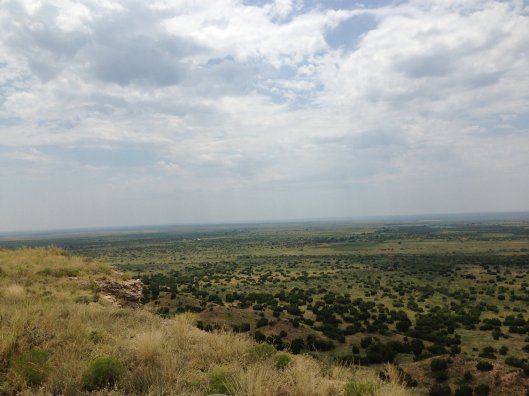
160 feet above the rolling plains

The view from 160 feet above the rolling plains.

There are reunions for other branches of my family, but this is the only one that I attend every year that I possibly can. I think it’s because this is where I’ll find my first cousins and many other relatives that I remember as far back as I have memories. It’s great to see the traditions of the reunion carry on even though my great-grandparents are long gone, and their many kids who lived in that farmhouse are mostly gone too.

The reunion happens at the peak heat of the Texas summer, because that’s when Great-Grampa’s birthday falls, and well, traditions die hard even when we’re facing the blazing sun and nighttime surprise thunderstorms. There are no name tags. I’ve actually started asking people I’ve seen for decades what their name is (or at least the name everyone calls them, which is often different), because they had never once said it to me directly. We’re just all comfortable sharing space without any formalities.

Most years during the reunion, a group of people set out to hike a spot near the Caprock Escarpment, which is a few miles away and clearly visible from the farmhouse. The Caprock is where the rolling plains rise abruptly up to the high plains. We love exploring this part of the landscape that our ancestors used to see from the house every day. The part we like to explore is a narrow ridge that juts out from the Caprock like a finger. As best as I can calculate, the top of the ridge is about a 160 foot vertical rise from where the base starts to level out below, and another 90 feet to where we start the hike. For people who are used to scaling mountains, it doesn’t appear to be a very challenging hike, but there are plenty of extra challenges along the way, including rattlesnakes, loose rocks on steep slopes, black widows, prickly pear, and very little shade from the intense summer sun. There is clear evidence of the presence of wild pigs on the trek to the base of the ridge. In fact, the only established trails are the ones made by the local animals. The clearest evidence I’ve seen of the pigs was the two I hit on the highway at night that tore up the front of my car. They can easily tear up a person, too, but I’ve never encountered one during the day except that one that we barbecued, and man was that good eating.

A few years ago, my then 67-year-old mother decided to try the hike, despite her frail knees. She hadn’t gone on the hike for some time, and she felt that this might be the last chance she had before her body couldn’t take it any more. It’s no coincidence that my father had not gone to the reunion that year. None of us who were there had the gumption to tell her “no,” but Dad certainly would have. She brought a walking stick, and offered an extra one to me.

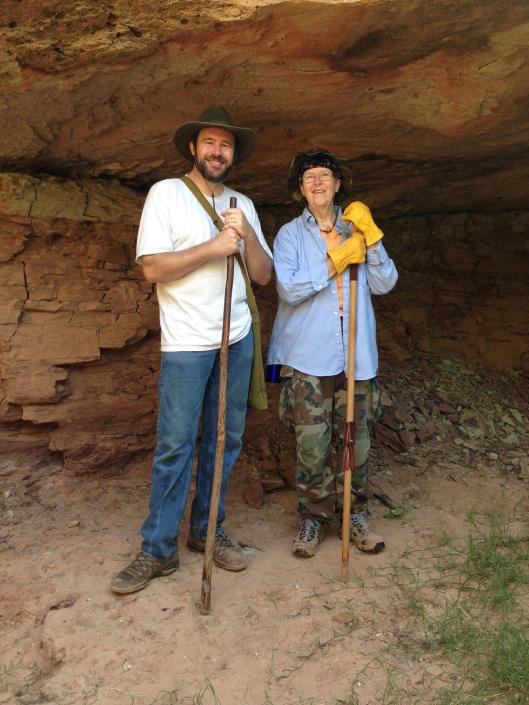
Mom and son

We paused for a picture on the way to the ridge’s north slope.

Eleven people covering a broad age range joined the hike that morning. Mom fell once on the way to the base of the ridge, but she got right up, not much worse for the wear. She started slowing down as we got higher, taking breaks more and more often. The last 10 feet or so is nearly vertical as you scale the hard top of the ridge. Mom was so exhausted we had to drag her up. As I pondered the wisdom of dragging her up there, I thought about how the route down on the other side would be more direct. I took a picture of her looking across the landscape from the top that’s one of my all-time favorite pictures of her.

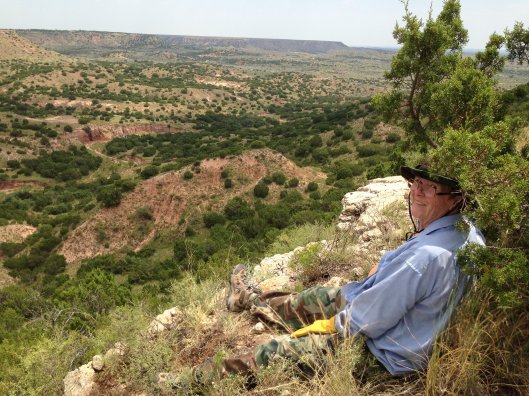
favorite picture of Mom

Mom is exhausted but happy. Facing north from the top, the main stretch of the Caprock is visible in the distance.

We rested at the top, hoping to regain some strength. All of the younger crowd headed back down, leaving my aunt, my uncle, me and Mom. As we snacked and rehydrated while we feasted our eyes on the expansive landscape below, we saw that Mom wasn’t recovering any of her strength. She seemed to be suffering from heat exhaustion. We had started our hike early in the morning, so we now had several hours before we would get any relief from the heat. Mom had difficulty standing up, and it was hard to imagine her getting back down from the ridge under her own power. I tried to stand so I would cast a shadow over her as we discussed what to do. The temperature was about 95º, a good deal less than the highest we’ve seen, but still we could feel the heat beating down on us. The breeze we often enjoy on the top of the ridge was sparse that day.

We decided to call for help. Cell phone coverage has improved in the area in recent years, but it still was challenging to find a signal from the top of the ridge. We needed more water, and something to repair a blown out sole on my uncle’s shoe. We asked for a tarp so we could fashion some sort of sling to get Mom down the ridge. We got through to the family at the farmhouse, and the rescue was underway. The ATVs that several families bring to the reunion proved useful in getting supplies to the base of the ridge quickly, and soon we had a bag full of water bottles and a roll of duct tape. Where would we be without duct tape, after all? But no tarp was offered–all the tarps that could be found were being used as ground cloths for tents, and they all had hundreds of sticker burrs embedded in them. We offered Mom more water, but she was feeling nauseous and couldn’t drink any more. She also tried to eat some cheese crackers, but couldn’t stomach that either. I’m thankful for whoever included some sports drinks in the bag, because I needed the extra electrolytes at that point. I had brought just enough water for an uneventful hike, but not enough for a rescue.

We struggled to make a plan to get Mom off the ridge. My aunt (Mom’s sister-in-law) sat with her, giving her a bit more shade, and kept talking to her to keep her calm and awake. They sang some songs, but they had to use some discretion a few times. They changed their minds about singing “Ding-Dong! The Witch Is Dead.” I vetoed “I’ll Fly Away”, though I love that hymn, because I know Mom wants to include it in her funeral. Some of our fears were cracking through our facade.

At some point, the decision was made to call for an air ambulance. However, the emergency medical services denied the request because we were too far away from where the helicopters were. It was pretty clear that we were on our own.

I grabbed the walking sticks and walked to the edge, thinking that I would throw them down the hill and recover them later. I needed to lighten my load. But I stopped myself, remembering my Boy Scout training about building a stretcher. If only we’d gotten that tarp! I walked back to the group, which now included several people from the farmhouse encampment who came to the top to help. I mentioned building a stretcher somehow, and one cousin immediately took off his T-shirt and offered it to me. I practically slapped myself over having forgotten that part of my first aid training. Another cousin offered a shirt, and soon we were building a stretcher with two walking sticks, two T-shirts, and the extra duct tape. I felt a little guilty for not thinking to use my own shirt, but I was feeling pretty exposed to the elements already and I was glad to have that little bit of protection from the sun.

lightning strike at night with a blue sky

A lightning strike near the farmhouse in the dead of night lights up white clouds and a blue sky.

We decided to go down the slightly steeper south side because it would give us easier access to get vehicles to the base. There’s a trail taking a nice easy slope angling across the south side, but it’s too narrow to accommodate the width of two people plus a stretcher. So we decided to go straight down. I’m guessing it’s about a 35º slope on average, starting with a vertical drop down several feet. We loaded Mom on the stretcher and down we went. We had six people holding the stretcher at a time, so if one or two people fell, the stretcher would still be secure. We found out pretty quickly that we had to build a headrest to keep Mom’s head from banging on the rocks that were just a few inches below her head on the high side of the stretcher. More duct tape to the rescue!

As people got tired, someone else would rotate in to hold the stretcher. It was rough going. Normally when walking across the rugged terrain, you take a wandering path, avoiding large rocks, cactus, and scrub brush. But with six people walking in the same direction, you don’t have much choice of where to get a foothold. I lost my footing a lot, and one time I fell completely underneath the stretcher, sliding downhill for a bit. We all had to take a break at one point, so one inventive family member sat down near the downhill end of the stretcher and held that end in his lap so we could set the stretcher down.

After we started our descent, we saw a patrol car that stopped at the end of a dirt road in the distance. Two sheriff’s deputies made their way toward us from the car, and one of them scaled the hill to meet us. He didn’t hesitate to join the rotation of stretcher carriers. Our call for help from the authorities didn’t come up totally empty after all.

My 21-year-old daughter also made her way up the hill and joined the rescue. I was fatigued at that point so I gave her my spot. She explained that she had been told that only menfolk were going to help and she should stay behind. She said “That’s my Granny up there!” and got in the car anyway. There might have been a few, uh, emphasizing words she added that I chose not to remember. I congratulated her for sticking to her guns. She was an accomplished athlete after all, and could certainly be a help.

Back at the farmhouse, tensions were high as everyone waited for news of Mom’s well-being. After the first call for help, adrenaline peaked as supplies and people were quickly gathered and sent on their way. But then that energy had nowhere to go. I had another daughter there who had some health issues, and she had argued with her sister about staying behind. Many of the remaining men were champing at the bit to join the rescue party, but others were pleading with them not to get in the way if there was enough help already. Some people were praying, and some were endlessly pacing. The person who is our best organizer for many things related to the reunion expended a great deal of effort coordinating the phone calls. It seems the anxiety was higher at the farmhouse than it was even on that hill, where we were focused on the task at hand.

Pretty soon I had given all that I could. Having helped Mom up that darn hill, I didn’t have the energy to get her all the way back down. My uncle and I both sat down on the hillside to rest. We had more than 30 people participating in the rescue operation, some on the hill and some providing support at the bottom. The stretcher crew continued down to the base where one of my cousin’s Jeep was waiting. I managed to get myself the rest of the way down. We loaded Mom in the back, lying down. We heard that an ambulance was waiting on the nearest paved road. Another cousin drove the Jeep, tearing through the landscape, right over prickly pear patches and even a few of the thorny mesquite trees. Our driver hadn’t driven the Jeep when she came over to the Caprock, so she didn’t have a good recall of what the route was. We lost all sense of where the roads were, and I had to use my phone to get our bearings to find our way to the ambulance. I couldn’t believe that the tires on that Jeep were still intact, though the paint was all scratched to hell. Our driver ignored us as we warned her that the car was taking damage. She was on a mission. The Jeep’s owner shrugged it off later, saying that that was her contribution to the mission.

Mom had this recollection of her journey down that hill–

I cried most of the way down, but I covered up my face with a damp bandana because I thought that seeing that would make things harder for the ones carrying me. And I prayed that we were making enough noise to scare away snakes. I was so afraid someone would get hurt because of my determination to hike. I was exhausted and felt old and stupid. And my hair kept getting stuck in that duct tape and that hurt. For some reason, both my feet were hurting badly, but I didn’t say much about it because I just couldn’t think of anything we could do about it.

prickly pear cactus

Prickly pear cactus tends to hide in the scrub. The fruit are good to eat if you have the patience to get all the tiny spines off.

We rolled up to the ambulance that was waiting some distance down the road. When we said that Mom had fallen, the paramedics were concerned and insisted that they take her to a trauma center some distance away. We told them that the fall wasn’t really the issue, and we convinced them to go to a smaller hospital in a nearby town.

I headed back to the farmhouse, where family expressed concern about my own condition. I was exhausted and dehydrated, as were most of the other rescuers. I found more electrolytes and took the coveted seat next to the window air conditioner in the house. You have to get pretty close to the air conditioner to get much of the benefit from it in the poorly insulated house. After a while I had recovered well enough to go with a carload of people to visit Mom in the hospital.

It was a pretty routine case of heat exhaustion. Perhaps it would have become a life-threatening case of heatstroke if we hadn’t taken action when we did. Mom’s sister, who’s an X-ray technician, insisted on reviewing the X-rays herself to make sure there was no damage from the fall. In the hospital room, someone noticed an orange trail on the floor. Mom explained that they must be crushed cheese crackers that had been in the cargo pocket on her pants. Her brother, who was also holding vigil in the room, dropped down into his chair and said “Oh, thank God.” He had grabbed her leg there earlier and felt a sickly crunching sensation. He had been afraid he had crushed the bone. Only then did he realize how silly that fear had been.

Mom checked out from the hospital, and we all went to the Dairy Queen for supper. It occurs to me that eating out with my aunts, uncles, and cousins is a rare event, though we’ve eaten home-cooked meals together countless times. I like the homemade food better. Mom had been very reluctant to call my Dad to tell him what was going on, but around this time she finally filled him in. I don’t think he’s going to miss another reunion.

Many of us who were involved in the rescue were due to go home that same day. As I drove to get back to my daily routine back home, it felt surreal having been through that experience. It still feels that way.

A few days later, the rescue was written up in a local newspaper. The article was filled with wild inaccuracies, like the slope being nearly 90º, and it minimized the family’s role in the rescue. The deputies were commended, and I’m fine with that. I was glad to have them there. Mom made commemorative bandanas for the family with “We take care of our own” printed on them. Those who participated in the rescue got a star added on the bandana. I can’t help but think of star-bellied Sneetches, but I digress. Mom kept the stretcher as a souvenir, and the guys didn’t mind not getting their shirts back.

the terminus of the ridge

The terminus of the ridge viewed from below the south side.

I’ve had a few years to reflect on this experience. Is my family special? Wouldn’t other families also take care of their own? Surely they would. We’re special in how tight-knit we are, though our links to each other on the family tree get looser with each new generation. We still show up in great numbers to see each other every year, so we had plenty of able hands at the ready when someone needed help. Maybe another family would have been smarter about letting a 67-year-old grandmother scale a hill, or maybe they would have figured out how to treat heat exhaustion while still on the ridge so she could come down under her own power. Who knows? I like my family’s sense of adventure, though I do regret both the family and public effort that was ultimately required to recover from being a little too adventurous.

Most people in the family are proud to identify as rednecks, with the conservative politics and religion that goes along with it. That doesn’t describe me at all, but they let me hang out with them anyway. I can identify with the part of the macho redneck bravado that motivates people to get a job done without whining when it really needs to be done. But the part where the women are expected to stay in kitchen needs some updating. I hardly ever listen to country music, but I was happy to find common ground with my aunt recently when she was complaining that old-fashioned country music is better than what the kids are listening to now. Right on. One family member who played a prominent role in the rescue is someone who has made decisions both before and after that day that I take strong exception to. Typical dynamics found in any family, I suppose. He certainly earned some respect that day, and it showed me that no one is all bad all the time.

There's beauty all around in the harsh landscape

There’s beauty all around in the harsh landscape. Mom, you don’t have to climb up high to find it. 🙂

I’m glad that Mom got her one last chance to see the beautiful landscape below the Caprock with her own eyes. Actually, knowing her stubbornness, I won’t guarantee that it was her last chance, but she darn well better have a creative plan for getting back down if she ever tries it again.

Wikipedia: overcoming the difficulties in joining an online community

I have given myself a challenge that I’m enjoying right now – immersing myself more deeply in the Wikipedia community. The culture that has developed around the people who add to and edit Wikipedia bears some resemblance to the culture that we see with users of services like Facebook, Twitter, and Slack, but it’s much more complex. I aim with this article to convey a sense of the richness an online community can develop, and the frustration that an outsider can feel, much like a physical community. Maybe I’ll convince you to be a Wikipedia editor too.

First I’ll mention another online community that encourages its members to make contributions that everyone can benefit from. I made an attempt to become a productive contributor on Stack Overflow, a web site for asking and answering questions about computer programming.

Stack Overflow uses a reputation system, where various contributions you make will increase your reputation score. Additional features becomes available when your reputation grows. I thought that building a good reputation on Stack Overflow could be something I could add to my resume. I answered a few questions, and was able to especially build reputation when I answered questions that no one else had answered. But I had trouble finding questions that hadn’t already been thoroughly answered within minutes of being posted. And I was chastised a few times for not strictly following the rules when I posted answers, which was disheartening when I had put effort into answering the question. I understood that a community should have rules, but I lost interest before I really learned enough of the rules to be productive on the platform. I went back to only reading the content on the site, which, like many programmers, I do often.

I created my Wikipedia account way back in 2003. According to the contribution log, which shows almost every detail from the beginning, this must have been because I wanted to add a new article about load testing. I had made some edits to other pages without an account, but I needed to have an account to create a new article. That article is still there today, and I’m happy to see that after hundreds of edits, some of my original phrasing is still there.

Wikipedia newbies would be wise to hold off on creating new articles, however. I have added a total of seven articles. Of those, two have been converted to redirects to other articles with a broader scope, and one was deleted. I created an article about Brian Marick in 2007. Amazingly, it lasted until 2016 before someone claimed that he was not notable and eventually got it deleted. Recently, someone created an article about Janet Gregory, and within 24 hours, someone started a proposal to delete it. It was deleted 8 days later. For many topics, perhaps especially for articles about people, it’s quite difficult to prove that they meet Wikipedia’s notability guidelines. It must be sad when someone sees that they’ve been declared non-notable. I will probably not be adding new articles any time soon.

My long tenure on Wikipedia has caused others to assume that I’m well-versed in the rules of the road, but with my off-and-on interest in contributing, I’m just beginning to absorb the elaborate set of rules and conventions that editors are subjected to. In response to an edit I made to the article on Jerry Weinberg that was not up to snuff, one editor told me “Surely you know by now that ‘he told me so himself’ is not considered to be adequate sourcing for anything here…” Unlike a traditional encyclopedia with articles written by trusted experts, everything on Wikipedia is expected to be backed up by published independent sources.

I find it rewarding to make edits that improve the content on Wikipedia. Doing the research to justify the edits helps me to build my knowledge. I can refer to the article later when I want to refresh my knowledge of a subject, and so can anyone else. But the benefits are greatly reduced if the changes aren’t accepted by the community. In the case of my edits on the Jerry Weinberg article, I swallowed my ego and asked how I could change my approach. This led to a healthy discussion, and I was successful when I used a different approach. It’s often not easy to engage in this sort of discussion when I’m still smarting from having someone erase my work.

I recently decided to get more involved with Wikipedia because of efforts by Noah Sussman and Alan Page. Noah put a lot of effort into improving the Wikipedia article on software testing. Then Walter Görlitz, another volunteer Wikipedia editor, removed a big edit that Noah made to the article, an action that Wikipedia calls a “revert.” A heated discussion ensued, and little progress was made on overhauling the article like Noah wanted to. Alan issued a call for help to figure out how to effectively improve the article (A call to action: let’s fix the Wikipedia page on software testing), and I and several others joined a discussion on a chat group outside of Wikipedia to strategize.

I decided to take an agile approach; make small changes and watch to see how the broader Wikipedia community responds. A few of us have also branched out and looked at the many other articles related to software testing and found that as a group, they aren’t very well coordinated or well written. We’ve made numerous small changes to these articles now with a great deal of success, though we haven’t made substantial progress on the original goal of completely revamping the software testing article. I’m starting to make somewhat larger edits now and I hope others do too.

Instead of wondering how Walter would react to my edits, I decided to engage with him directly, so I invited him to open a dialogue. I’ve seen that he puts a great deal of effort into improving and reverting vandalism on a large number of Wikipedia articles. Walter tells me that the small edits I’ve made successfully has improved my reputation with him, and he is now less likely to revert the changes I make. Unlike Stack Overflow where reputation is tracked in one place, on Wikipedia your reputation is earned individually with each editor.

I’ve found that the best way to get consensus on Wikipedia is to use the “talk page” feature on the site itself, so everyone who is following the changes on the page have an opportunity to respond. In fact, the Wikipedia community prefers for discussions like this to take place on Wikipedia, otherwise some editors may get suspicious that one person is trying to recruit a cabal of “meatpuppets” to artificially amplify their influence. Our chat group is very loosely coordinated, and the edits we make are all an individual decision, so I’m not worried that we’ll raise this suspicion, especially now that we’re using the talk pages more.

The response to an edit can vary significantly based on who is watching for changes on the article. Many areas don’t happen to have anyone watching closely, so whether the edit is useful or not, it may stay around for years. If someone feels strongly about maintaining the quality of a particular article, you’ll be held to a higher level of scrutiny. I’ve also found that newly added information may be held to a higher standard than what is already in an article. Once I added some information to an article without including a citation to back it up, and the information was removed, despite the fact that most of the information already in the article was also not referenced. It was just easier for the editor who did it to revert a recent edit than to address the broader problem. You can avoid this if you scrutinize your own contributions very carefully.

If you’re afraid you’ll have difficulty getting edits on Wikipedia to stick, take this to heart, from the instructions to “Be Bold” with your edits:

Think about it this way: if you don’t find one of your edits being reverted now and then, perhaps you’re not being bold enough.

Now if you’ll excuse me, that load testing article has become a bit of a mess.

My thanks to Simon Morley and Walter Görlitz for helping me improve this article.

Respect for the old folks

I enjoyed reading Andrew Wulf’s blog post, “The Future Is Always Different Than You Can Imagine. He looked back 36 years to his first day of work as a programmer:

On that first day I wore a suit to work. Everyone did. No one had a computer on their desk. We had a bullpen with terminals (both IBM and Harris) that you signed up for time on and thus were shared resources. On that first day I met two “old guys” who did batch programming on the IBM, they worked on multiple projects at a time as they got only one compile-run cycle a day. They had started programming, of a sort, in the late 1950s on some kind of analog computer involving plugging in wires. They seemed so old and wise. They were much younger than I am now.

These “old guys” seem very much like my friend, Jerry Weinberg, who used digital plugboard computers after he started working for IBM in 1956. His experience with analog computers was mostly in replacing them with more modern digital computers. It’s fun to imagine how he viewed the old folks using those analog computers when he first started programming.

Do we look at the old folks now with the same respect that Andrew did in 1981? I respected Andrew when I was working with him a handful of years ago, though he didn’t seem that old then. I think it’s difficult for the old folks to get much respect now. I’ve seen some who don’t want to embrace the technology changes as fast as they’re coming, so they find pockets in the industry where older technologies are still used. Or they use the authority they’ve gained as “old folks” to hold their organizations back from adopting the changes.

I do appreciate it when I find the industry veterans who are following along with the changes, like when Jerry talks about agile processes and ties them back to things he’s been doing all along. Andrew, thanks for the perspective.


Jerry’s Story: More Early Jobs

I found a few jobs I left out of the “Early Jobs” post, and they’re worth sharing, so here’s an addendum. As always, I feel obligated to point my new readers to the home page for Jerry’s Story for links to other installments.

It was during Jerry’s undergraduate years at the University of Nebraska in Lincoln that Jerry got a summer apprentice job at 3M in St. Paul, Minnesota. The year was 1952 or 1953. His job was to find a way to recycle the abrasive material that comes off of sandpaper when it’s being used. The challenge was to capture it and then separate it from the adhesive that had adhered it to the paper. He put both his physics and his chemistry coursework to use on the project. He was working for Arthur Fry–Jerry called him Art. Jerry doesn’t know whether any of his sandpaper ideas were developed any further, because he left the job before the summer was over. He missed his girlfriend, Pattie, so he want back to Omaha and married her.

Jerry lost touch with Art, but he did notice when Art achieved his greatest success a few decades later. Frustrated by the bookmarks in his hymnal that frequently fell out, Art put a new adhesive that had been developed by a co-worker on the back of a small piece of paper, and the Post-It Note was born.

Jerry and Pattie were in Lincoln for the start of his next school term. They rented an apartment in a former mortuary, with the kitchen set up where the embalming room had been. Jerry remembers that kitchen fondly because it was very spacious and yet had no unfortunate reminders of the room’s former purpose.

By the next summer, they both found jobs in Milwaukee. Jerry’s older sister, Charlotte, worked at a department store in Milwaukee as a buyer. Her boyfriend invested in a new business, the Eddie Mathews Bataway. But the business needed a lot of help, and Charlotte recommended Jerry. Pattie got a job in a hat factory in Milwaukee, so they moved there for the summer.

The Milwaukee Braves had recently moved from Boston, which threw Milwaukee into a frenzy of excitement over getting a Major League Baseball team. The Eddie Mathews Bataway wanted to harness some of that excitement. Eddie Mathews played for the Braves, and would later be called one of the best third baseman of all time when he was inducted into the Baseball Hall of Fame. Mathews was a partner in the Bataway business.

The Bataway was in trouble. They had bought pitching machines from the lower of two bidders, but still investing a significant amount of capital. The machines arrived unassembled and with no assembly instructions. They didn’t know how put them together, and the supplier of the pitching machines had disappeared. Every week they delayed was costing thousands of dollars, and once baseball season was over, they would be closed for the winter.

Charlotte told her boyfriend that Jerry was a “mechanical genius.” While he was growing up, Jerry had tinkered with his father on a wide variety of things including home repairs, fixing electrical devices, and doing body work on cars. This gave him the reputation and the skills to help the batting cage business. Jerry was hired, with the promise that if he could get the pitching machines working, he would get the cushy job of managing the Bataway. They rented a garage, hired two gofers to help, and Jerry got started.

Less than a week later, two of the pitching machines were working. The Bataway was open for business as Jerry worked on the rest of the machines. He had to make several adjustments, including filing and taping the “pitching hand,” which was two long parallel “fingers” on an arm creating a track for the ball to roll up as the arm came up and flung the ball forward.

Eddie Mathews made a few appearances at the Bataway, which was a thrill for Jerry, who had tracked baseball statistics from a young age and enjoyed playing baseball himself. Jerry was able to hone his skills in the batting cages when business was slow, but he never found an opportunity to play on a baseball team again as his career progressed. But an even bigger thrill was the money he was earning, more than he had been paid for any job before.

The most memorable part of the job for Jerry, though, stemmed from the fact that the Eddie Mathews Bataway was built on top of a landfill that spanned at least five acres. The landfill supported a population of flies of legendary magnitude. Jerry said,

Swatting flies was about the most interesting thing about the job, unless one of the machines broke and had to be fixed. I soon set myself a goal of killing 100 flies a day, but that turned out to be too easy, so I raised my goal to 200. That also was too easy, and by the end of the summer, I was up to 500 a day.

A parade of inventors came by to pitch their fly control solutions. One that they tried consisted of an inch of yellow liquid in the bottom of a gallon-sized jug. This actually worked so well that the jug would be full of flies in about four hours. No matter how many jugs they put out, they would all be full in short order, and the flies kept coming. Jerry abandoned all hope of slowing the fly onslaught and swatting flies just became a way to pass the time. He constructed a giant fly swatter that could kill a square foot of flies in one blow, all the while recalling the fairy tale “The Brave Little Tailor” who killed seven at one blow.

At the end of the summer, Jerry and his wife moved back to Lincoln for the next term at the University of Nebraska. But Jerry’s most lucrative job to date left them with no more savings to pay for school expenses. Most of their money was spent at restaurants because the apartment they rented in Milwaukee had an ancient stove with an oven that had two inches of grease in the bottom. They never used it. Jerry was angry with himself and he resolved to start being more diligent about saving money. Their last $100 was spent on a speeding ticket they got in the middle of the night in Mount Horeb, Wisconsin on the way back to Lincoln.

Now, more that 60 years later, Jerry hasn’t gotten another speeding ticket since then. He feels a connection to Mount Horeb that perhaps helps him to remember to watch his speed. Jerry likes the fact that his middle name, Marvin, is the name that people occasionally choose when they Anglicize the Hebrew name Moshe or Moishe. The more common Anglicized name is Moses. The Moses many of us know received the Ten Commandments on Mount Horeb. And Mount Horeb, Wisconsin was named after the biblical mount. Through this tenuous connection, Jerry has managed to both improve his driving record and save a lot of money.

Coming up in the next installment, we’ll explore more about Jerry’s schooling, starting back before he enrolled in elementary school: “Jerry’s Story: The Student (Early Years).”

Jerry’s Story: Early Jobs

This is the fifth installment of the series of posts about Jerry Weinberg’s career–see the home page for Jerry’s Story for links to other installments.

Jerry says that he learned a lot from every one of the many jobs he has held. His entry into the world of work started about the year 1944, at age 10 or 11, when his family lived in Chicago. He took a job delivering a weekly newspaper that contained mostly advertising. He had a big route in the northern suburbs. To carry all of the newspapers, he tied a cardboard box to the handlebars of his bicycle using a rope. His pay came from what the recipients of these newspapers paid, but payment was voluntary. Jerry was tasked with asking the recipients to pay for it, and of course not very many people did, so it wasn’t a lucrative job for him. His clearest memory of the job was his last day. A sudden rainstorm hit while he was on his route and far from home. With no way to protect his cargo from the rain, he watched the newspapers and the box disintegrate into pulp. When the box fell on the ground along with its contents, he reflected on how much the job was worth to him. He abandoned the remains of the newspapers along with the job itself, and pedaled for home. He didn’t tell his employer he was quitting, and he doesn’t recall ever hearing from them again.

Around the same time, Jerry also started to earn money by babysitting. He liked kids, but he also liked seeing how other people lived. A voracious reader, he loved to read the books on the shelves where he was babysitting. More generally, though, he saw that families didn’t interact with each other the same way his did. Jerry was often affected by his mother’s irrational behavior—he describes her as “nutso.” He doesn’t like to discuss the details of this and perhaps other painful family interactions. Learning that the interactions he had with his mother weren’t normal was a matter of survival. Looking back on it, he said he can apply a motto he eventually adopted: “Things don’t have to be this way.”

photo credit: Dave Hensley

He later had a job as a soda jerk, first at one drugstore in Chicago, then at another, over the course of two years. At one, he remembers that he was paid 30 cents an hour. The minimum wage was 40 cents an hour, and he was supposed to make up the difference in tips. But he only got a tip once, a dime, when he delivered some prescriptions to a third-floor walk-up apartment. He felt this discrepancy was easily made up for by the fact that he was allowed to eat all the ice cream he wanted.

He used his unlimited ice cream privileges to experiment with different combinations of syrups and ice cream flavors. One summer day, the store featured fresh limeade, and also peppermint ice cream, so he decided to make a milkshake out of both. He realized his mistake after the first sip, but here’s the problem–whatever treats he made for himself, he was required to drink all of it. His boss looked on as he drank the full glass of milkshake that had been curdled by the lime juice. This concoction make him feel so ill that it was a very long time before he wanted to taste any lime juice or peppermint ice cream.

In his next job, Jerry learned the grocery business as a stock boy. He filled in for absent stock boys in all departments at Hillman’s, a large grocery store for its time in Chicago. The grocery store experience came to bear years later when he wrote about “Rudy’s Rutabaga Rule” in his book The Secrets of Consulting (pp. 14-15):

“But mostly I noticed the rutabagas. I not only noticed the rutabagas, I made their acquaintance. I appreciated that each rutabaga had a distinct personality, and week after week I recognized the same rutabagas smiling at me from the same produce section. Evidently, nobody ever bought rutabagas. Rutabagas were just a permanent decoration, smiling their happy smiles at all the shoppers.

“One morning, I was standing in the produce section with Rudy, the produce manager, trying to figure out how to place the fresh vegetables in the limited counter space. Rudy had wrestled with this problem for a long time but didn’t seem to be getting anywhere. He asked if I had any bright ideas–and suddenly I was a consultant!

“‘I’ve noticed,’ I suggested, ‘that the rutabagas don’t seem very popular. In fact, they seem to be the least popular vegetable we have in the store. Would it be any great loss if we didn’t use any counter space for the rutabagas and used it maybe for something else?’

“Rudy looked at me sideways. I knew I was in serious trouble for implying that a mere, temporary stock clerk could help him solve his problems. But he had asked for help. To my surprise, he suddenly smiled and grabbed an empty banana box. Sweeping the rutabagas into he box, he said, ‘That’s a great idea, kid.’

“I beamed with a consultant’s pride. For the first time in my life, an adult had actually listened to me and taken my advice. Rudy looked at the void left by the departed rutabagas, then looked at me, then at the many vegetables that still had to be stocked, then at me again. After a long pause, he said, ‘Well, kid, that was a great idea. Now what’s the least popular vegetable?’

“Once you eliminate your number one problem, number two gets a promotion.”

After Jerry started high school, his family moved to Omaha. He had gotten his driver’s license in Chicago at age 14, but found that as a Nebraska resident, he couldn’t legally drive until age 15. This didn’t deter him from getting a job as a parking lot attendant in Omaha. He was required to keep it legal by only driving the cars on the lot.

Jerry’s father bought Wayne Auto Body in Omaha, and the rules there were more lax. Jerry helped moved cars on the lot and delivered them to their owners when the repairs were complete. This was done more for fun than as a job, but it did come with the perk of being able to borrow some of the cars. His favorites to take out on the town included a Cord luxury car, an antique Ford, and a flatbed truck that somehow got a lot of attention from the other kids.

Also while in high school, Jerry had a summertime night job at the Omar Baking Company. His job was to use an adding machine to calculate how much of each product to bake for the next day based on the order than came in, and he also ran the telephone switchboard for the last incoming phone calls of the day. Before he took the job, his boss had taken all night to do the calculations. Now Jerry was doing it in less than two hours. The bakers were delighted to get the numbers they needed so much earlier, but he had to convince his boss that he was actually done, by proving that his calculations were correct. There was another problem—Jerry was paid hourly, and finishing so quickly was going to drastically cut the pay he was expecting to get for working a whole shift. With the backing of the bakers, he was able to negotiate getting paid for the whole 8 hour shift even though he was finished with his work in significantly less time.

Jerry isn’t sure how he was able to complete his calculations so much faster than his boss. A few factors were probably at play. He started the calculations while still working the switchboard, but his boss had waited for all of the calls to be finished first. Also, he was doing many of the simpler calculations in his head, and his accuracy was good enough that his calculations didn’t need much verification.

A few of the bakers would drive him home in the wee hours of the morning, usually after expressing their appreciation by giving him a fresh loaf of bread. They would often stop at a bar for a drink. He wasn’t old enough to be in a bar at all, but he didn’t have any trouble coming in to enjoy a ginger ale.

An earlier installment mentioned Jerry’s summer job as a camp counselor after he graduated from high school, and some of the jobs he had while he studied at the University of Nebraska in Lincoln. There were a few other jobs that helped get him through college, like moving furniture for Eno Cabinet Works, where he learned that there was no shame in asking for help with a job, especially when that job involves moving a grand piano.

He worked at a greasy spoon restaurant that he often heard referred to as a “cancer kitchen,” based on the assumption that either the quality of food or the lack of cleanliness was likely to make the customers gravely ill. He started as a dish washer and later was a short order cook. He liked the dish washer job better, even though the pay was less. He liked being able to set the pace when he was washing dishes, and being able to see clearly when the job was done. Working as a cook, he tended to burn himself, and he didn’t like the pressure of having to get the orders out. He still enjoys washing dishes.

Jerry tried his hand at sales as a shoe salesman. He was very successful at selling men’s shoes. When helping men buy shoes, his approach was just to explain the properties of the shoes, which he felt were well-made. Then he just had to find the right size, and he had a sale. He was the top salesman for men’s shoes. But he believed the women’s shoes at the store were “cheap cardboard crap.” He explained the quality of the women’s shoes to his potential customers without sugar-coating it, and he never sold a pair. He felt he was doing the women a service. His employer, however, wanted salesmen who could sell any of the shoes they offered, so he was fired.

One summer while back home in Omaha, he had another job involving sales. He worked for a siding company, driving around rural areas of Nebraska and Kansas looking for houses where aluminum siding could be installed. He would ask the occupants questions that would qualify them as a sales prospect, and if that went well, he would try to schedule a time for a salesman to visit that evening. He would come back to introduce the salesman and then silently observe the pitch. Three weeks into the job, he saw a salesman give a high-pressure pitch to a poor farm family. He decided he didn’t want to take advantage of people like that, so he quit.

Also while working his way through his undergraduate studies, Jerry worked for a frozen food company, both in their storage locker and driving a delivery truck to make deliveries to grocery stores in Eastern Nebraska. This was when the frozen food business was in its infancy. While working at this job, he turned down an offer to take a full-time job in Florida with an orange juice company, so he could continue his studies.

Starting with his first two jobs, Jerry learned the benefits of having more than one source of income at a time. This insulated him from being influenced by threats from managers. Several times, managers have asked him to do something he didn’t feel was right to do, with the understanding that his job was on the line. He ignored the threats, being unafraid of losing the job, and he never did lose his job as a result. For all his career, he tried to avoid relying solely on one employer.

Jerry also learned that feeling exhausted from a job was a warning sign that he wasn’t doing it right. He would back off and allow the people he was working with to do more for themselves. He has applied this approach to many areas, including parenting, consulting, and training.

His most unlikely source of income while in college was from gambling. Jerry estimates that he earned half of his college expenses from gambling, which was a common pastime then. The bulk of his gambling earnings was from playing poker and hearts. He was good at it, and he would even be able to win repeatedly from the same people. Jerry said, “People always have an explanation for why they lost, and that explanation never involves their intelligence or ability.” He also played bridge. He and his bridge partner won two college bridge championships, but this wasn’t as lucrative as the other card games he played.

Jerry was awarded a National Science Foundation fellowship that supported him and his first wife through graduate school at the University of California, Berkeley, so his next job would be the the one that finally introduced him to the world of computers at IBM. We’ll explore this further as we look at Jerry’s role as a programmer.

The next installment in this series is Jerry’s Story: More Early Jobs.

Jerry’s Story: The Roles of Jerry Weinberg

This is the fourth installment of the series–see the home page for Jerry’s Story for links to other installments.

You may be wondering, “Who is Jerry Weinberg, anyway?” I have much more to learn before I can competently answer that question, but for the sake of my blog readers who are following along as I put the story together, I’m going to set a foundation as best I can. I expect that I’ve been able to uncover some surprises even for people who know him well.

34522523915_f33801d393_k

Jerry in his office in Corrales, New Mexico (May 2017)

His given name is “Gerald Marvin Weinberg,” and the name that you’ll see on his books and articles is “Gerald M. Weinberg.” But if you talk to him, you’ll learn that he’s always just gone by “Jerry.” My first exposure to his work was reading one of his most popular books, The Psychology of Computer Programming. First published in 1971, that was his fifth book. I discovered it 25 years later.

I decided to learn more from him by taking the Problem Solving Leadership (PSL) workshop that was developed and taught by Jerry and his colleagues. My employer at the time wouldn’t pay for it, so I satisfied myself with joining the more affordable online SHAPE forum (an acronym for “Software as a Human Activity Performed Effectively”), which Jerry moderated. Many people who had learned from Jerry hung out there and shared their wisdom.

A few years later, I finally arranged to participate in PSL. I followed up by participating in the “Change Shop” workshop as well. I enjoyed these experiential workshops so much that I attended a workshop on how to design experiential workshops. I have been in touch with Jerry off and on ever since.

Here are the roles that I think best explain who Jerry Weinberg is:

The Programmer
Jerry started his career as a programmer, and he continued to work with software programming, testing, architecture, and management throughout his career. He is the designer of the world’s first multiprogrammed operating system, used for NASA’s Project Mercury.

The Author
Many people discover Jerry through one of his books, which are the way he has been able to reach his largest audience. My most conservative count is 36 non-fiction books and 16 fiction books that he has authored or co-authored. This doesn’t count books that were later split into multiple volumes, translations, republished books, new editions, his doctoral thesis, short stories, or books he edited or contributed to. All told, Jerry estimates that he has been through the book publishing process about 100 times. He started out writing books for computer programmers. Jerry reports that his first book, Computer Programming Fundamentals, was the best-selling computer book of all time not long after it was published in 1961.

The Student
Jerry wants to always be learning, so much so, that if he feels that if he isn’t learning new things fast enough, he gets out of whatever situation that is stifling his learning, no matter how lucrative or prestigious. His love for learning is at the center of most of the things he does.

The Teacher
Jerry’s love for learning also applies to seeing other people learn. He has a rich history of teaching, starting while he was still a student. He found opportunities to teach while he was a programmer, as a college professor, and as a consultant.

“I always learned more through teaching than sitting through conventional classroom boredom.” -Jerry Weinberg

The Consultant
After working for IBM for about 12 years and teaching at SUNY Binghamton for three years, Jerry started working full-time as a consultant, a role which has defined the bulk of his career.

The Counselor
Jerry is known not only for consulting with high-tech organizations, but also for helping other consultants improve their craft. He is often called the “Consultant’s Consultant.” His mentor, Virginia Satir, also taught him a lot about family counseling, and his high-tech clients sometimes took him aside to ask for more personal advice. Jerry translated many of Satir’s counseling techniques into a form that engineers could use on the job. He also founded Consultants’ Camp, which still runs to this day.

The Human
I’ve discovered some interesting stories that help us to see Jerry as human. He is a son, brother, husband, father, and grandfather. He was once arrested for vagrancy. He paid for half of his college expenses with his gambling earnings. He briefly ran a computer dating service without actually using a computer. And he helped organize teach-ins in the 1960s.

I’m going to explore all of these topics more thoroughly in future posts. Stay tuned!

The next installment in this series is Jerry’s Story: Early Jobs.