• About
  • Jerry’s Story

swalchemist

swalchemist

Category Archives: Jerry’s story

Jerry’s Story: Jerry, the Real Programmer

24 Wednesday Aug 2016

Posted by Danny R. Faught in Jerry's story

≈ 1 Comment

This is the third installment of Jerry’s Story. See the home page for Jerry’s Story for links to other installments.

Jerry Weinberg had worked as a shoe salesman, dishwasher, and camp counselor, among many other jobs. But he was finally getting to work with the “giant brains” that he had hoped to get his hands on. He asked to start two weeks early because, he says, “I had a wife and 1.66 kids by then, so I needed the two weeks’ pay.” Still living in Berkeley, he commuted across the bay to San Francisco on the F-train.

The first machine he used on the job was the two-ton IBM Type 607 Electronic Calculating Punch, which IBM also referred to as an “electronic calculator.” The term “computer” was in use at this point in the 1950s, but it doesn’t seem to have yet become the most common term for these machines. The job ad he had responded to referred to “electronic data processing machines.” It didn’t matter to Jerry what they were called—he was fascinated by these machines.

He hadn’t known that unit record equipment like the 607 had been in use since the late 19th century. Unlike the era of the IBM PC, which made IBM a household word in the 1980’s, IBM wasn’t marketing these data processing machines to consumers, so their existence wasn’t common knowledge.

Jerry was IBM’s first applied science representative in San Francisco. His first assignment was to teach a programming course to the three other applied science representatives who were starting two weeks later. He would soon be providing technical sales support to help salesmen sell leases for data processing machines and other IBM products. IBM would also send him to new customers at no additional charge to teach them how to program the computers, which usually also involved writing their first program for them.

8791024600_b4c3b971c0_k

Plugboard, system type unknown. Photo by Simon Claessen.

There was no training available for learning how to program, but there was a set of manuals. Jerry dug in to the manuals for the 607 and mastered the machine in a week. This was a wired program machine, programmed by plugging wires into a plugboard. [Note from the editor: The 607 was a data processing machine, not a stored program computer.] He still easily remembers the technical details—20 wired program steps (this was expanded from the base model with 10 steps) and one signed ten-digit number of data storage. This was a big advance over the desk calculators he had used before. He also got familiar with other machines, like the keypunch, verifier, reproducing punch, collator, printer, and sorter. Some of these could also be programmed in limited ways, such as formatting and adding totals with a wired program on the printer, or defining the formatting for the cards on the keypunch using a special program card.

Jerry earned a reputation as a whiz kid by making the 607 do tricks. He won a dollar bet by turning on all the lights on the 607 control panel, which no one else in the office had figured out how to do. Jerry sums up his feelings about his new job: “I was being paid $450 a month for playing with the world’s greatest toy, a job I would gladly have paid $450 a month to do—though I wisely didn’t tell IBM that.”

Jerry moved on to learning how to program the IBM 650 Magnetic Drum Data-Processing Machine before the San Francisco office had one available. This was the world’s first mass-produced computer, and the first stored program machine that he encountered. The machine arrived a short time later.

There is a legendary story about Mel Kaye, the “real programmer.” Mel wrote hand-optimized programs for the Librascope/Royal McBee LGP-30 and RPC-4000 computers, which had storage on a rotating drum like the IBM 650. Mel implemented tricks like placing instructions on the drum so that after an instruction executes, the next instruction would have rotated to the read head at the moment it was needed. This eliminated the need to wait for the drum to rotate to the instruction before reading it. There was an optimizing assembler, but Mel’s hand-coded machine language programs always ran faster than the equivalent automatically optimized assembly program.

In order to optimize the amount of space a program occupied on the drum, when he needed a number in a calculation, Mel would try to find an instruction code in the program that happened to have that number, so he could just refer to the same memory location rather than adding another storage location to hold the data. The ultimate optimization described in Mel’s story involves using features of the machine that aren’t documented at all.

To learn about his competition, Jerry later wrote a few programs for the LGP-30, though he didn’t have a chance to run them. Recalling the IBM 650, which was similar in some ways to the LGP-30, Jerry says that the kinds of manual optimization described in Mel’s story were very common, and necessary if you wanted to have an efficient program. The optimizer might even cause a correctly written program to crash the computer. There was an assembler called “SOAP” (Symbolic Optimizing Assembly Program) that tried to place the instructions in an optimal location on the drum. Jerry says, “SOAP was okay for many programs, but for critical apps, we optimized by hand.”

Ed Nather, the person who wrote Mel’s story, was the programmer who tried to understand Mel’s code. It was a convoluted mess, almost impossible to decipher. Most of the Mel’s optimizations made the code harder to change, but even so, Ed wrote of his awe of Mel’s programming prowess. Programmers at that time did not consider maintainability an important attribute for their programs.

One of the optimizations that Jerry applied was on the IBM 704. There were many possible values for machine instructions that were not documented. Programmers were expected to only use the codes (often called “opcodes”) that were documented and supported. But of course, some of the programmers were curious, so they experimented with the undocumented opcodes, and found that a few actually were useful. One of them was a single instruction that would clear a memory word—the supported way to do this required two instructions. They coined a new instruction, Store Zero (STZ).

Someone added the STZ opcode to the assembler that was distributed by the SHARE user group, so all 704 programmers could use it and reduce their program size. Later when IBM produced the 709 and claimed it was compatible with the 704, Jerry and other programmers found that the STZ instruction no longer worked. They pressured IBM to add the STZ instruction so that they wouldn’t have to modify every program that used it. IBM complied, but if they hadn’t, the programmers would have had a big job in modifying their programs to work on the 709.


Less than a month after Jerry started the job, IBM chairman Thomas J. Watson Sr. died. This inspired a lot of talk in the office that informed Jerry about company history. It can be interesting to trace the machines of IBM’s roots to what Jerry experienced there starting in 1956. IBM started life as the Computing-Tabulating-Recording Company, which itself was formed from the merger of four companies in 1911:

  • Computing Scale Company of America—manufactured “computing scales,” scales similar in function to modern butcher scales, which weighed a product and calculated its price at the same time. They also made meat slicers (you can watch a video of a hand-cranked IBM meat slicer). Jerry only encountered these scales and slicers via the stories people shared about the history of the company.
  • International Time Recording Company and Bundy Manufacturing Company—both interrelated companies manufactured time clocks, tracing their roots to the world’s first time card recording company. Jerry never got involved in selling time clocks, but he does remember being required to punch a time card, simply because it was “part of our business.” When IBM sold the time recorder business to the Simplex Time Recorder Company in 1958, Jerry hopefully asked if he could stop punching a time card that didn’t really help anyone. The answer was “no,” but in fact the practice of punching in and out did fade away in his office. Bundy also got involved in producing adding machines, but these didn’t seem to make their way into IBM’s DNA.
  • The Tabulating Machine Company—Founded by Herman Hollerith, who built a tabulator that successfully processed the data for the 1890 census in the U.S. This machine was the first in a long line of unit record equipment, which includes the IBM 607 that Jerry started with, and evolved into modern computers.

One more later acquisition is worth mentioning here–

  • Electromatic Typewriters, Inc.—IBM entered the typewriter business with this acquisition in 1933. Jerry helped sell “a slew of typewriters,” which established his reputation in the office. He remembers that a typewriter salesman was making a pitch to a biologist who was doing genetic research. The biologist wanted to buy several IBM Selectric typewriters, but he needed to be able to make the standard symbols representing males and females. The salesman couldn’t find a typeball in his catalog that had those symbols, so he sought out an applied science representative to help. Jerry remembered that these symbols were also the astronomy symbols for Mars and Venus, and with this help, the salesman sold five typewriters. After that, salesmen started to bring a variety of problems for Jerry to help solve.

The next installment in this series is Jerry’s Story: The Roles of Jerry Weinberg.

Jerry’s Story: An aspiring auto mechanic changes course

24 Sunday Jul 2016

Posted by Danny R. Faught in Jerry's story

≈ 2 Comments

Part 1 of my telling of Jerry Weinberg’s story was Jerry’s Story: First interactions, where he had started his college studies in September of 1950. But let’s go back to the summer of 1950, when Jerry had no plans to attend college at all.

Jerry had graduated from Omaha Central High School, and he felt disgusted with school. He found many of the subjects in high school to be trivial, so he had skipped most of those classes and still got good grades. He did enjoy a few classes, however, especially auto shop. He told me “I just loved cars, driving them, working on them, even washing them—plus doing body work and painting in my father’s shop. I never really had any other career idea than working with cars in some way.” Though he was fascinated with computers, there were so few jobs available to work with them at the time (and none that he was aware of) that he didn’t even consider a computer job a viable option.

After graduating from Central High, Jerry applied for a job as a mechanic. The owner of the garage offering the mechanic job, however, wouldn’t let him start until after the next school term started. He suspected that Jerry was just looking for a summer job, but he really wanted a long-term employee. Jerry decided to wait out the summer so he could get that job, and in the interim, he worked as a summer camp counselor for a camp sponsored by the Omaha Jewish Community Center. At the camp, another counselor encouraged him to go to college so he could meet young women. Jerry had a keen interest in women, and hadn’t before considered this particular benefit of the college experience. So he determined to go to college instead of taking the mechanic job.

A few days before classes started in the Fall, Jerry showed up at the University of Nebraska in Lincoln to register. The counselors were not happy that he hadn’t registered in advance, but because he had graduated from a Nebraska high school, state law required that they admit him. The counselors were even less happy to find that they had to give him a scholarship because he had graduated in the top ten percent of his class. So he began his studies.

While at the university, Jerry got a job in the Physics department—the job title was “computer.” It turned out that Jerry would be a computer years before he programmed one. He used a Friden electromechanical calculator along with pencil, paper, and eraser to invert 10 by 10 matrices for faculty members. Just as a computing device doesn’t know the ultimate reason it does its work, he doesn’t recall ever knowing why they wanted the inverted matrices. Jerry told me about what he learned from this job:

I recall that it took me upwards of an hour to invert a 10 × 10, and of course the inversion time tends to grow as the square of the size. Going to 11 × 11 would have raised my computation time by over 20%, and increased my chance of making an error somewhere along the line. That was the first time I became aware of non-linear computation times and also the significance of error. It was a good start to my career: my understanding of these factors, which many programmers today don’t seem to appreciate.

He also offered his services as a tutor for any subject, primarily for failing athletes, and he worked grading English papers. He was a Physics teaching assistant and was told he was the first undergrad to get that job, at the ripe old age of 17.

Jerry was out sick with Crohn’s disease for most of his second year. He went home to Omaha to recover. While there, he took a few courses at the University of Omaha (now known as the University of Nebraska Omaha), including Mathematics of Finance. He thought that computers would be used in course, but he had no such luck. There was most likely no computer on campus at all.

When the course progressed to more advanced subjects like probability, statistics, and risk, Jerry found out he knew more about them that the professor did, so he helped teach the class. This impressed the instructor, who was an associate of Warren Buffet. The professor recommended that Jerry meet Buffet because he was seeking bright math students to work with. Jerry wasn’t able to arrange a meeting, however, because he had to return to the hospital for surgery.

During his stay in Omaha, Jerry did manage to meet with the chief actuary at Mutual of Omaha. Jerry was impressed with the luxurious office, but not impressed with the actuary job itself.

He returned to the University of Nebraska and completed his Bachelor of Science degree, magna cum laude and with honors, for four majors: Physics, Math, Philosophy, and English. He then moved to California to study Physics at the University of California, Berkeley. A year later, he had passed his comprehensive exam, finished his thesis experiments, and was on track to earn a PhD in record time. He had a few months of work left to finish writing up his thesis when he found the opportunity he had been looking for since he was 11 years old.

Jerry was out of cash, and supporting a wife and a child, with the second child on the way. He read an ad in Physics Today from IBM looking for applied science representatives. It didn’t say that the job involved computers, though there was a picture of a roomful of data processing equipment. It’s not the first computer-related job ad that Physics Today ran, but it was the first that he noticed. He had no doubt that this was what he wanted to pursue. He wrote to IBM to apply, interviewed in Oakland, and was offered a job on the spot. He also interviewed at Boeing and got an offer for more than twice what IBM offered, but the job did not involve computers.

Accepting either job would mean not finishing his PhD. Jerry says “The degrees were irrelevant to me, but came along as a side effect of my hanging around. My advisor actually cried when I told him I was leaving.” He received a Master’s degree in Physics from UC Berkeley as a consolation prize. Jerry was hired for his dream job as an applied science representative at IBM on June 1, 1956.

I’m sure that Jerry would have found a way to play with computers before long, even if it weren’t for that wary garage owner, the fortuitous advice from his fellow camp counselor, or the worry about paying his family’s expenses. But I was fascinated to see the path that he took to realize his dream.

An excerpt from the ad in Physics Today, which ran in the January 1956 and March 1956 issues. You can see a full scan of a very similar ad from the February 1956 issue of Scientific American.

physics-today-ibm-ad

Can you help to provide additional details from your own knowledge of this era or from your interactions with Jerry? Please comment here or contact me on Twitter.

The next installment in this series is Jerry’s Story: Jerry, the Real Programmer. Also, there is a home page for Jerry’s Story.

Jerry’s Story: First interactions

08 Friday Jul 2016

Posted by Danny R. Faught in Jerry's story

≈ 9 Comments

My friend Jerry Weinberg was present at the dawn of the age of computers. He can describe first-hand what that was like, but much of his story has never been told. I have started to collect Jerry’s stories. Here is a small sampling, which I prompted by asking him “What were your first interactions with a computing device?”

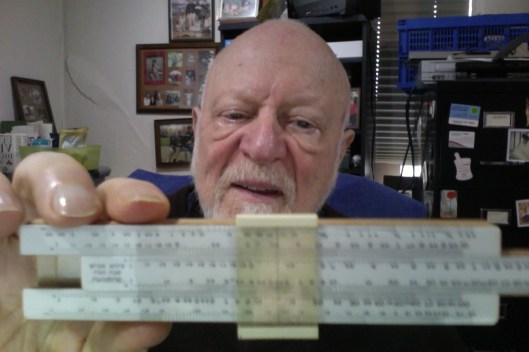
The first thing that Jerry used that we could call a computing device is a slide rule that his father, Harry, gave him when he was about 7 years old. Harry worked for more than 20 years helping to improve processes at Sears, Roebuck & Co. He bought slide rules in quantity to give to the young ladies who computed customer bills. They used slide rules to check their multiplication, for example, when multiplying price times quantity. This practice caught an enormous number of errors before the bills were sent to customers.

Jerry had a more interesting use for his slide rule, though. He was a sports fan, so he used the slide rule to compute baseball batting averages. Jerry says “It’s the easiest thing in the world. A 7-year old could do it.” He still has that slide rule.

Jerry slide rule

He has a “UNIQUE” brand slide rule, made in England. Jerry describes it as small and cheap, with a table of “Trigonometric Ratios” on the back, which he didn’t understand how to use when he started using the slide rule. Later, though, he remembers using tables of sines, cosines, and logarithms, which could also be considered computing devices of a sort. He used the tables in math classes and also for experimenting with numbers for fun.

Jerry remembers his first introduction to the concept of computers being a Time magazine article. This may have been “Science: A Machine that Thinks,” in the July 23, 1945 issue, when he was 11 years old. That article discusses Dr. Vannevar Bush’s “memex,” a conceptual idea of a machine that stores facts for easy recall, which the Time article refers to as a “brain robot.”

The first book that Jerry read about computers was Giant Brains, or Machines That Think, by Edmund C. Berkeley, published in 1949. This book had a strong influence on Jerry, and he considers Berkeley one of his heroes. Much later, he met Berkeley and had long conversations with him, and he was delighted to know that Jerry had been inspired by his book.

Jerry may also have seen “Science: The Thinking Machine,” the landmark Time cover story on January 23, 1950, when he was 16 years old. The cover artist for that issue, as it was for many issues of Time, was Boris Artzybasheff, which is a detail that Jerry still recalls. The article discussed the Harvard Mark I named “Bessie” (which coincidentally is also Jerry’s mother’s name). This was an electromechanical computer that had been in operation since 1944. The article also discussed the Harvard Mark III, a hybrid electronic/electromechanical computer produced in 1950 and it went into detail comparing computers to the human brain.

Jerry was an avid reader. He explained just how avid: “I usually had breakfast alone, with cereal, so there was the box to read. I’m not saying it was my preferred reading, but just that I read everything that appeared in front of me. Like the see-food diet: I see food, I eat it. So, I see print, I read it.” He probably heard about computers from other sources during his youth. He remembers sitting at his father’s feet as his father read the newspaper and offered his commentary on a wide array of topics.

Jerry had been labeled as a “brainy” kid, and he yearned to learn more about brains, especially these “giant brains.” Early on knew he wanted his life’s work to be with computers. He didn’t yet know anyone who had ever seen a computer, let alone used one. He watched and waited for signs of a computer, but went all through high school without seeing one, with perhaps one exception. He had a summer night job in a large bakery computing recipe requirements for the following day’s orders. He used a Monroe adding machine.

When he entered college at age 16, Jerry told his counselors that he wanted to work with computers, but none of them knew anything about computers except that they had something to do with electrical engineering and physics. They decided he should major in physics because he was good at math, which they thought would be wasted in electrical engineering.

One day, Jerry saw a notice for a brief “computing course” using Monroe adding machines, given by the Monroe company. He already knew most of the material better than the instructor. He passed, earning a certificate that he’s lost somewhere along the way. It’s the only computing course he ever took, and the only “degree” in computing that he ever earned.

If you’re interested in hearing more of Jerry’s story, please let me know. He has much to tell. Note that many of the words above are his, and I decided to tell the story in third-person. Consider it a collaboration.

The next installment in this series is Jerry’s Story: An aspiring auto mechanic changes course. Also, here is the home page for Jerry’s Story.

Newer posts →

Recent Posts

  • Seeking the Inner Ring – Revisited
  • Use Your Unit Tests, or Else
  • Open-Minded Networking
  • Design Evolutions Doomed to Never Finish
  • Adventures in Personal Library Management

Recent Comments

Danny R. Faught's avatarDanny R. Faught on Seeking the Inner Ring –…
coutré's avatarcoutré on Seeking the Inner Ring –…
Danny R. Faught's avatarDanny R. Faught on Use Your Unit Tests, or E…
coutré's avatarcoutré on Use Your Unit Tests, or E…
Five for Friday… on Four Years after the 343

Archives

  • October 2025
  • September 2025
  • March 2025
  • August 2024
  • July 2024
  • June 2024
  • May 2024
  • March 2024
  • February 2024
  • February 2022
  • September 2021
  • August 2020
  • July 2020
  • February 2019
  • December 2018
  • October 2018
  • August 2018
  • June 2018
  • March 2018
  • February 2018
  • October 2017
  • September 2017
  • May 2017
  • August 2016
  • July 2016
  • June 2016
  • May 2016
  • September 2013
  • August 2013
  • November 2006
  • April 2003

Categories

  • archive
  • career
  • Jerry's story
  • life
  • security
  • software-development
  • technology
  • testing
  • travel

Meta

  • Create account
  • Log in
  • Entries feed
  • Comments feed
  • WordPress.com

Blog at WordPress.com.

  • Subscribe Subscribed
    • swalchemist
    • Join 26 other subscribers
    • Already have a WordPress.com account? Log in now.
    • swalchemist
    • Subscribe Subscribed
    • Sign up
    • Log in
    • Report this content
    • View site in Reader
    • Manage subscriptions
    • Collapse this bar
 

Loading Comments...